BUTTERFLY CONSERVATION IRELAND ANNUAL REPORT 2025
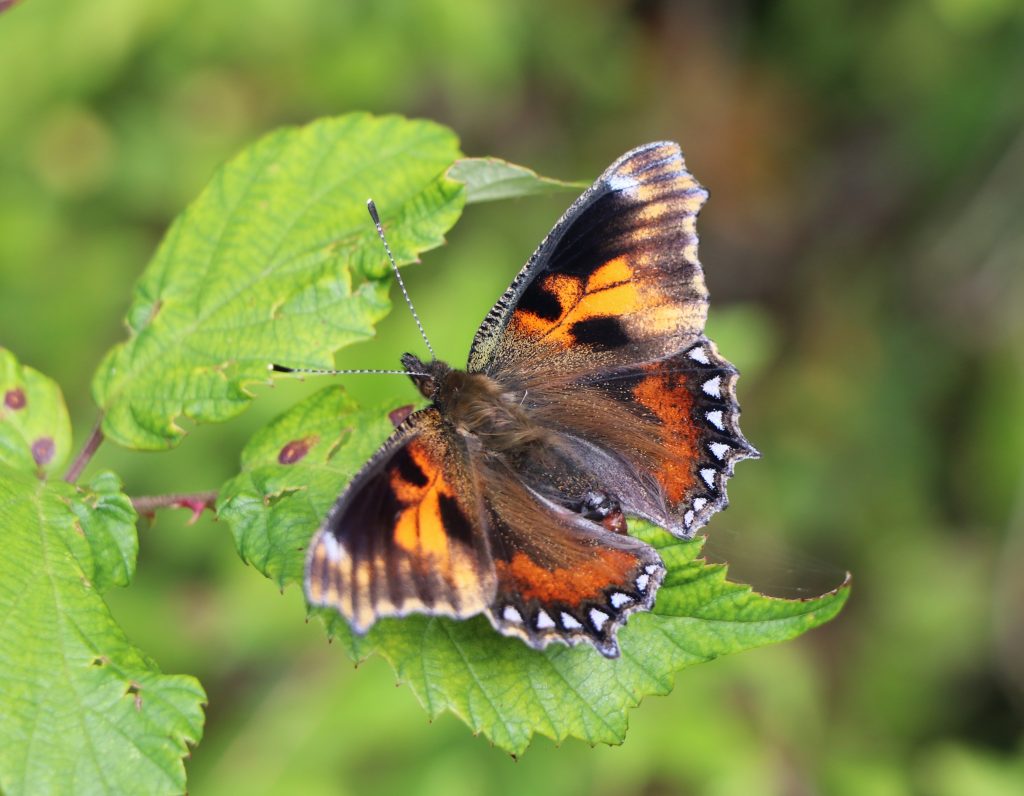 Small Tortoiseshell aberration. semiichnusoides Pronin 1928. This is caused by extreme heat during the larval or pupal stage. Photo: Kevin Healion
CONTENTS
- Introduction
- Red Admiral at Howth
- Butterfly Season Report 2025
- Crabtree Nature Reserve Report
- Conservation News
- Garden Survey Report
- Much About Moths
- Species Focus: Silver-washed Fritillary
INTRODUCTION
Dear Members,
2025 was eventful. Characterised by continued warfare in Ukraine, international trade tensions, the focus on demonstrations of power, European decline, indications of a return to 19th-century gunboat diplomacy and empire building, 2025 has set 2026 up for continued uncertainty. The stability of the post-World War II era has evaporated. In a world of shifting power structures, many countries are committing to increased military budgets.
There is a correlation between military conflict and biodiversity decline. In the 1900s, Fritz Haber and his colleagues extracted nitrogen from the atmosphere to produce Ammonia from which Nitric Acid is made, converted to the nitrates used in explosives. This development helped to keep Germany, hampered by the British naval blockade, in World War I for over four years. Post-war, nitrates were increasingly used in farming, replacing natural fertilisers to expand crop production. The resulting intensification has increased pollution, warmed the climate and ravaged wildlife. Other chemicals used in conflicts were applied to agriculture, such as Dichlorodiphenyltrichloroethane (DDT). DDT was applied to the clothing of troops fighting in areas where Malaria was prevalent, and after World War II was used as a pesticide, with terrible impacts on biodiversity. It has been banned in most countries but is still used in India and some African countries.
War often creates the drive to invent new ways to kill and protect. Many positive inventions, such as new surgical practices, have been developed during conflicts. However, we inhabit a world that cares for dominance, power, profit at the cost of nature. Unless we, as a species, learn to care for the world and adapt to our environment, instead of modifying it to suit ourselves, we could end up with nothing.
Our most beautiful wildlife offers the best way to encourage a love of our world. What would our world be without beauty? In 2026, we call on you to continue to care for butterflies, moths and their companion species in your gardens, local environs and further afield. Every butterfly matters. In a world where humans are exerting greater control over our environment, we must do this in ways to benefit nature, or at least leave room for it, as well as for us.
We thank everyone who contributed to this report and to all our members for supporting our beleaguered butterflies. We hope you enjoy this report, and we thank our joint treasurers, Michael Jacob and Joseph Harding, for managing our finances. Thanks to Pat Bell for his help in editing this report and to all our members and supporters. We hope that you enjoy reading our Annual Report, and we look forward to hearing from you in 2026.
Yours in nature, Jesmond Harding, Secretary Butterfly Conservation Ireland, Butterfly House, Pagestown, Maynooth, County Kildare.
WINTER RED ADMIRALS AT HOWTH by Frank Smyth
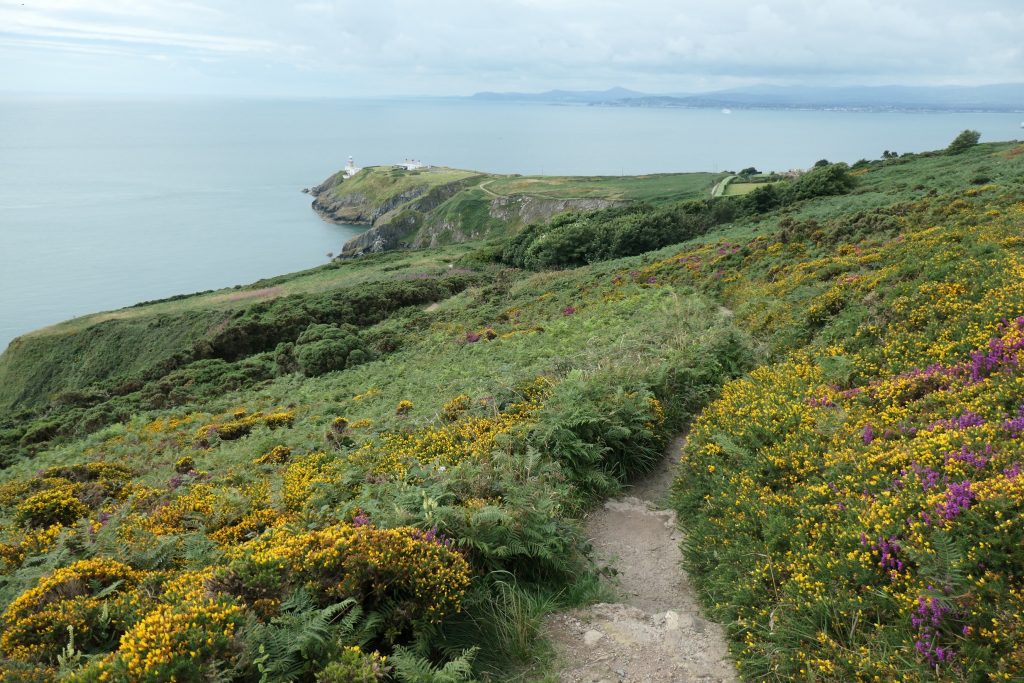 A view of Howth looking south. The Baily Lighthouse can be seen near the end of the headland.
Frank Smyth has been recording butterflies near his Dublin home for many years, and in County Donegal, where Frank hails from. Frank is co-author, with Robert Aldwell, of The Butterflies of Donegal. In this article, Frank describes his discovery and ongoing study of how the Red Admiral is transitioning from being a migrant to a year-round resident in the Howth area.
My affair with the Red Admiral began in the early Noughties. I started a weekly transect in 2004 at the Cliff Path, Howth, between Drumleck Point and the Baily Lighthouse. Little did I know at the time how fortunate I was when I decided to start my Red Admiral project in 2006. That year was an extremely prolific year for migrant butterflies and moths. In addition, winter and spring 2006/7 was exceptionally mild. In 2004 and 2005, I noticed that the last butterflies to be seen each year were Red Admirals, which were present in small numbers in October and November, with occasional adults in flight throughout the winter and spring. During a conversation I had with Bob Aldwell in 2005, he mentioned that he had observed a Red Admiral ovipositing at Dalkey Hill on 30 October 2001. He subsequently reared the egg, which produced an adult the following April.
In 2006, I finally observed a Red Admiral laying on 31 November 2006 at the Cliff Path near the junction with Ceannchor Road. I subsequently noted laying at different nettle beds along the Cliff Path and at places at Carrickbrack and Red Rock. I then decided to investigate what happened to the eggs.
I marked up to about 100 egg-bearing nettles with white cotton thread at five different sites, four close to the sea cliffs and one a little further inland and monitored these across the winter/spring. That year, 2006, the laying continued until 8 December. At this time, a few very small larvae were evident, while some eggs were present until early January. Some eggs and larvae were destroyed in winter storms in less sheltered areas, but eventually four larvae at the Ceannchor Road junction reached the final instar stage and pupated, while 2 other larvae at another site also reached the final instar, but I lost track of them. Likely, they pupated as well. Adults from the November eggs emerged on 26 and 27 April and on the 1st and 17 May. The period from egg to adult ranged from 175 to 197 days with an average of 187 days.
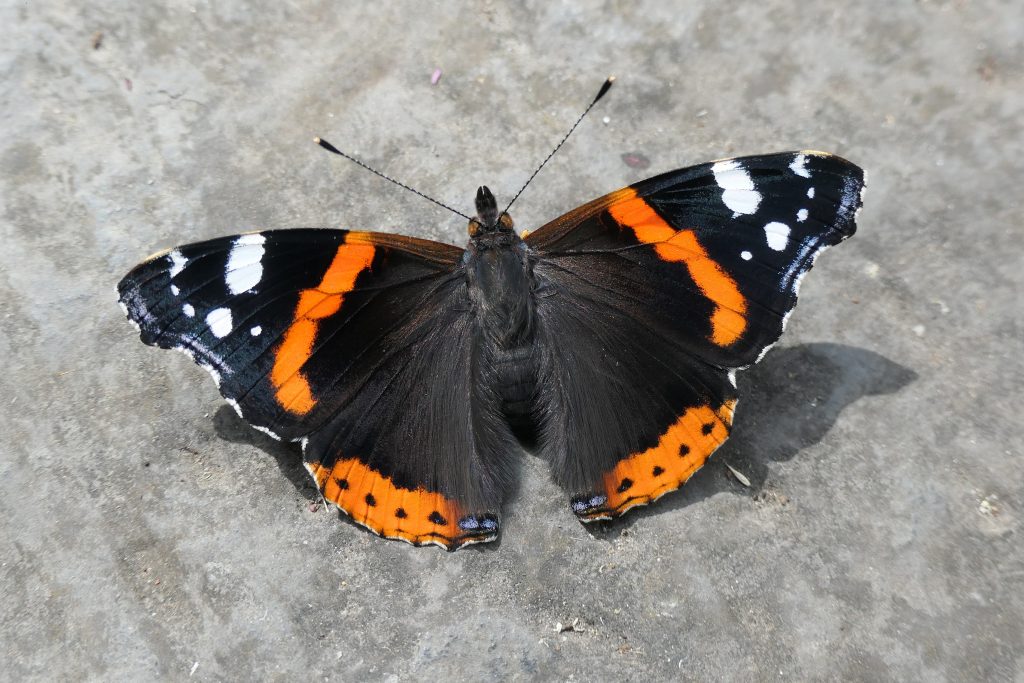 Red Admirals are fond of basking
In March 2007, egg-laying resumed on the 13th with an adult observed ovipositing on a small group of nettles at the Ceannchor Road junction with the Cliff Path. It produced 9 eggs. One of these eggs subsequently produced an adult on 16 June, a total of 96 days from egg to adult. It was 25 days in pupation. It was difficult to determine if it was a migrant or a Howth-born Red Admiral which laid, but I think it’s likely to have been a migrant.
While I did not do another intense investigation in 2008 or subsequent years, I have always checked for Autumn laying each Autumn since. Currently, I check a short stretch around the Ceannchor Road junction and nettle beds at Carrickbrack and Red Rock.
The main reason for this Red Admiral activity at Howth is that its mild microclimate allows nettles to thrive all year round. Similarly, plants like Hebe also flower there in the winter, which provides nectar for the occasional migrant which may visit then. I am sure there are other favourable sites along the East and South coasts. On a visit to the Raven Wood in Wexford on 22 November 2007, I found one Red Admiral and two eggs, so, probably, Autumn laying occurs there too.
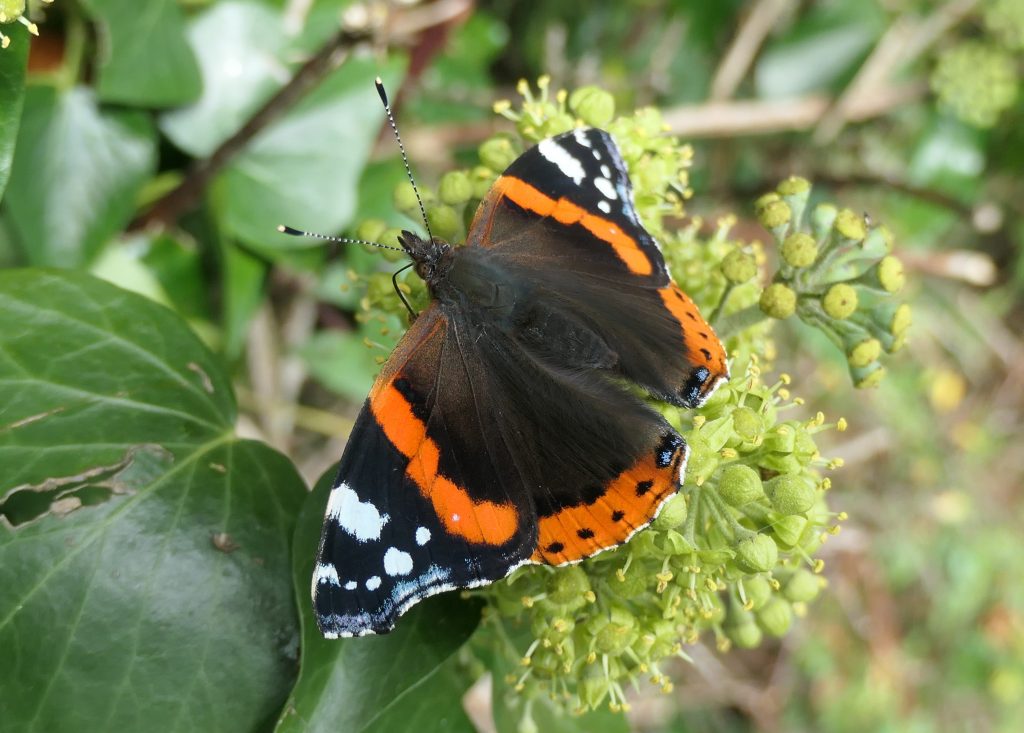 Autumn Red Admirals are fond of flowering Ivy.
Over the 20 years that I have been recording Red Admirals at Howth, the earliest Autumn laying was on 4 October, and the latest so far is the 8 December. While I started my Red Admiral project in 2006/7, Dave Harris, who is with Sussex Butterfly Conservation, was pioneering Red Admiral studies there, and at that time his findings were roughly similar to mine at Howth. Since then, Red Admirals have dramatically increased their winter presence in Sussex, with their latest laying date now 29 December and the earliest date is 3 January. Sussex Butterfly Conservation now regard the Red Admiral as a resident rather than a migrant. Obviously, Howth has a good way to go yet, but with ever milder winters, this will happen.
Analysing my Howth project, several things have stood out. The first thing is to recognise that the Red Admiral is a very hardy and resilient butterfly. It can stand cold and will fly in cloudy weather, particularly in September, when feasting on ivy bloom before many of them go south to warmer climes. They can postpone laying during dull and cool weather and resume under milder temperatures.
It was amazing to note their ability to prolong stages of their lifecycle during the winter months. Eggs can remain as long as four or five weeks before hatching in milder conditions. Larvae, usually second instar, can remain in the same tent during January and early February before progressing to new tents with milder weather. The difference between the November 2006 eggs to adult emergence, at an average of 182 days and the March 2007 egg at 96 days, is quite dramatic.
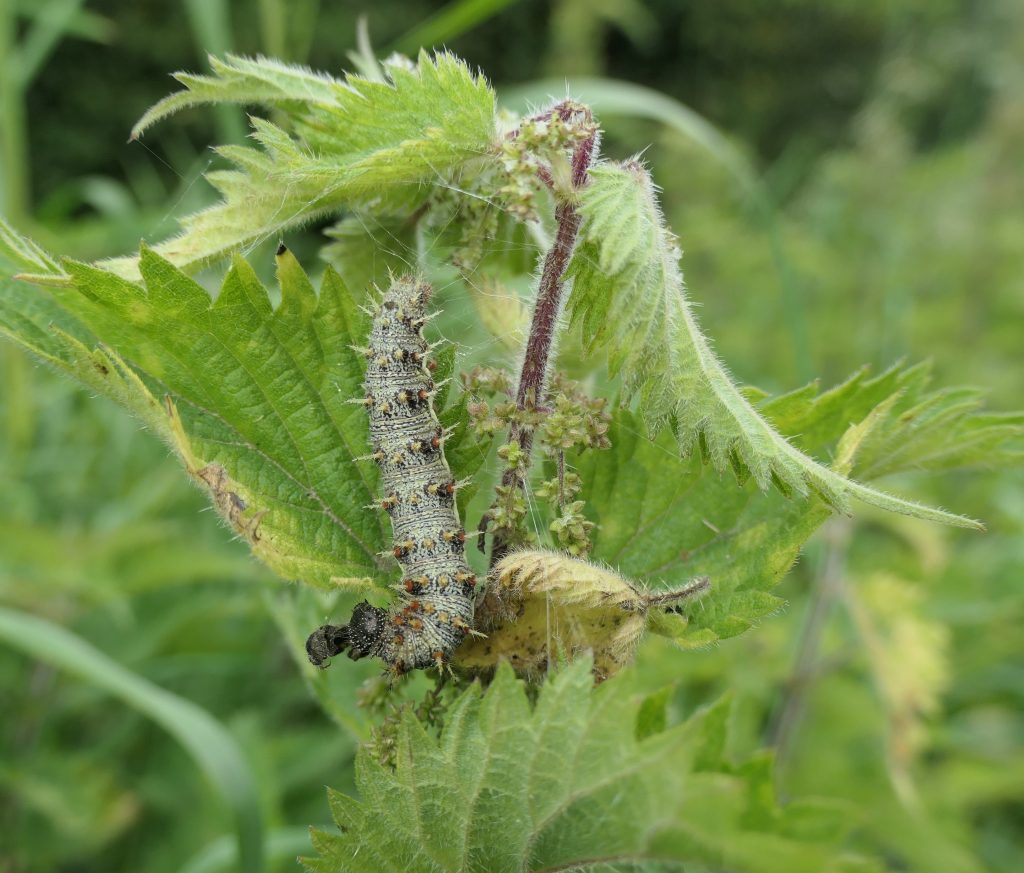 Red Admiral caterpillar, yellow form.
Another interesting feature was regarding the colour of the final instars. It has been found that in many of the butterfly species colour variances in their larvae can occur. The theory is that this is a thermoregulatory adaptation and studies of colour variation with temperature have concluded that darker forms are more predominant at lower temperatures. Based on this we would have expected the Red Admiral winter larvae to be black with a white stripe rather than its other colour of yellow with a deeper yellow stripe. All six of the 2006 final instars were the latter and the March 2007 larva was black with a white stripe. From discussions at the time with David Nash, the theory is that winter larvae spent most of their time tented within the leaves and only emerge occasionally to feed or move to a new tent. The lighter colour form may be an adaption to prevent loss of body heat.
While the Red Admiral’s egg-laying strategy of laying eggs, mostly singles, on the exposed upper side of nettle leaves, appears to be a negative feature in winter egg laying, it seems that this is not the case. K Porter in an article in 1992 in The ecology of butterflies in Britain, Oxford University Press, on “Eggs and egg laying”, states that an effective boundary layer of several millimetres above a plant’s leaf surface can result in a daytime temperature in sunshine greater than 20 degrees Celsius above the ambient.
In Howth, many of the nettle beds along the Cliff Path are facing south and take advantage of any sunshine going. Porter also went on to mention that Red Admirals are adapted to a “stop and go policy” which allows them to postpone laying and conserve energy during cool, dull and adverse conditions. This probably explains why Howth Red Admirals often lay multiple eggs at a time, three to five eggs on a single leaf, when temperatures fall below 10 °C.
There is still a view in some quarters that Red Admirals can hibernate during winter months, but I have not seen any evidence to support this theory.
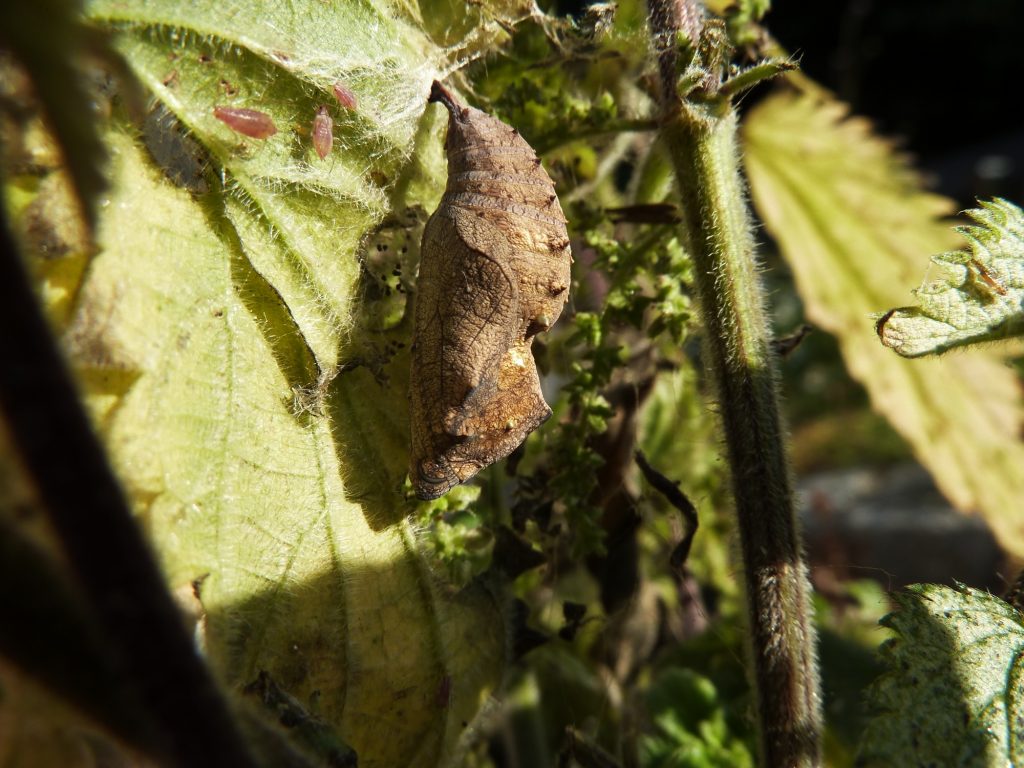 Red Admiral pupa.
2025 was a standard year for Howth’s Red Admirals. My first Red Admiral of the year was observed on 5 March at Carrickbrack. The Red Admirals gathered in some numbers in September to gorge on Ivy blossom, prior to many going south to Mediterranean countries. The remainder, mostly females, moved to nettle beds as soon as the Ivy began to stop flowering. I noticed laying from 22 October until 19 November. Eggs were still visible well into December. I am inclined to regard the occasional Red Admiral that I encounter from January to March as a migrant, but with the ever-milder winters and springs, I think that will change soon.
I think November/December eggs will shorten their emergence times and will eventually produce adults in late February/March. It will be impossible to distinguish Irish-born from migrant then. Given the remarkable instances this year where partial second broods by Dingy Skipper, Cryptic Wood White and Small Blue have occurred I am looking forward to finding out what 2026 has in store. Now that the Southern Small White has finally reached the UK, the Small White will need to be carefully examined in 2026 in Ireland. With identification being tricky to confirm it will probably be its larvae that will be necessary, initially, for confirmation. A lot to look forward to!
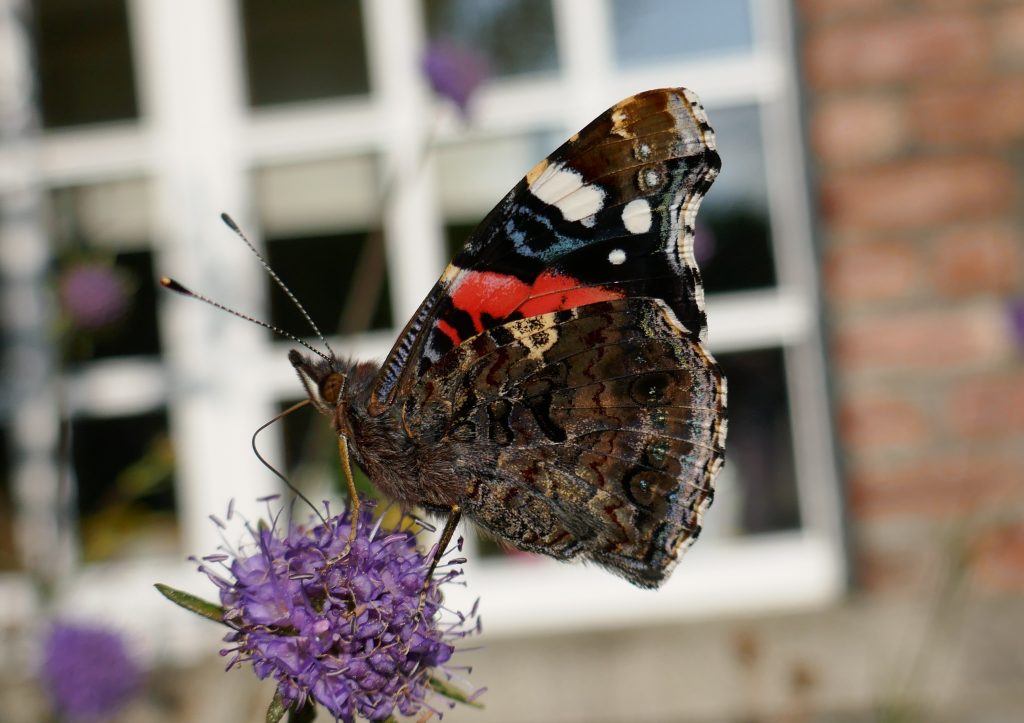 Red Admiral on Devil’s-bit Scabious
References
PORTER, K. (1992) Eggs and egg laying. In Dennis, R.L.H. (ed) The ecology of butterflies in Britain: 46-72. Oxford University Press, Oxford.
SMYTH, F and NASH, D.W. (2008) Overwintering of the Red Admiral butterfly (Vanessa atalanta) on Howth Peninsula, Co. Dublin. Irish Naturalists’ Journal, Vol.29, Part 2 December 2008.
BUTTERFLY SEASON REPORT 2025 by Jesmond Harding
The key influence in butterfly seasons beyond human control is the weather. Before describing how our butterfly populations performed during 2025, we will examine the conditions that prevailed during the year using the records compiled by the Irish Meteorological Service, Met Éireann.
Weather during 2025
Winter 2024/25 (December, January, February) was a mild winter overall, with both December and February seeing above-average temperatures at all stations. January saw below-average temperatures at most stations, due to a cold Arctic airmass descending over Ireland from the north during the first third of the month. Most seasonal rainfall totals across the country were below their 1991-2020 Long-Term Average (LTA). All mean air temperatures across the country were above their LTA for the season.
Spring 2025 (March, April, May) was the sunniest and warmest on record. It was also dry everywhere. All seasonal rainfall totals across the country were below their 1991-2020 Long-Term Average (LTA). All mean air temperatures across the country were above their LTA for the season. All available sunshine totals were above their LTA for the season. Percentage of seasonal sunshine values ranged from 138% (seasonal sunshine total of 630.8 hours) at Shannon Airport, County Clare (its sunniest spring on record (length 79 years)) to 139% (seasonal sunshine total of 633.8 hours) at Casement Aerodrome, County Dublin (its sunniest spring on record (length 61 years)).
Summer 2025 (June, July, August) was very warm overall and hot at times. It was the warmest summer on record. Rainfall was near the average. Percentage of 1991-2020 Long-Term Average (LTA) rainfall values were variable across the country. There was generally above average rainfall in the West and East of the country with below average rainfall in the South and Midlands. All mean air temperatures across the country were above their LTA for the season. Sunshine values were variable across the country. Percentage of seasonal sunshine values ranged from 102% (453.8 hours) at Shannon Airport, County Clare to 111% (528.2 hours) at Casement Aerodrome, County Dublin.
Autumn 2025 (September, October, November) was mild, after a cool September, and very wet. All seasonal rainfall totals across the country were above their 1991-2020 Long-Term Average (LTA). All mean air temperatures across the country were above their LTA for the season. Sunshine values varied across the country. Percentage of seasonal sunshine values ranged from 98% (291.0 hours) at Casement Aerodrome, County Dublin to 108% (297.4 hours) at Shannon Airport, County Clare.
The link between butterfly abundance and weather conditions
In general, extreme heat during spring and summer months benefits butterflies, while extreme heat in winter is damaging. Extreme precipitation is damaging to pupae of single-brooded butterflies and to adult butterflies. Drought generally hits butterflies that have more than one generation a year. Butterflies living in the general landscapes are more likely to suffer declines arising from weather extremes than species in better-protected habitats used by the rarer habitat specialists.
Weather conditions during 2025 benefited butterflies. We had high heat levels in spring and summer without suffering from drought. While winter temperatures were above average, these were not extreme highs. Mean temperatures for the season ranged from 5.1 °C (0.7 °C above its LTA) at Knock Airport, County Mayo to 8.5 °C (0.6 °C above its LTA) at Sherkin Island, Co Cork. The mean winter temperature (averaged over all weather stations) during 1991-2020 is 5.5°C. (Curley, M., Coonan, B., Ruth, C.E. and Ryan, C. 2024. Ireland’s Climate Averages 1991-2020. Summary Report. Met Éireann, Ireland.)
Caterpillar foodplants received the moisture, warmth and direct sunlight to promote healthy growth, while the warmth has accelerated the development of eggs, caterpillars and pupae, making them available to predators for a shorter period, and, in the case of species that can produce more than one generation of adult butterflies in one year, likelier to do so. The warmth has enabled butterflies to fly, feed, mate and lay eggs on healthy foodplants. In 2025, we avoided extreme winter heat, and prolonged extreme rainfall, and drought, which also damages butterflies. Warmth with normal rainfall during spring and summer is generally a positive for Irish butterflies. These conditions meant that Ireland’s butterflies had a chance to build higher abundance than they did in 2024, a year with very poor weather conditions. However, the populations in 2025 were beginning from a low base inherited from 2024.
Take the case of the Small Tortoiseshell, in devastatingly low in numbers in 2024. The weather conditions in 2025 led to higher populations after the crash in 2024. Why was the rise so dramatic? Some butterflies can produce more than one generation. The Small Tortoiseshell, a garden favourite was at a shocking low in 2024 (between 2008 and 2024, it declined by 63% (Judge and Lysaght, 2025)), but survivors laid their eggs on healthy nettles in good spring weather, developed rapidly producing a new generation as early as late May and in June; these in turn gave rise to a second generation that flew during July/August, some early in July, and some of these are likely to have produced a third generation, which was abundant by mid-August 2025. These are now in hibernation as adult butterflies.
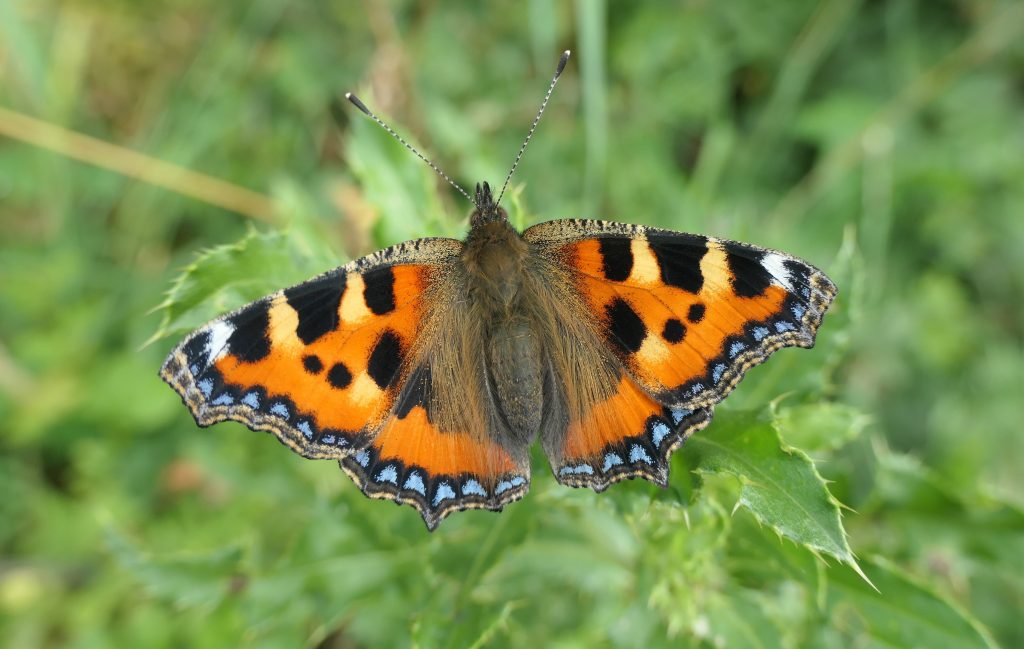 After a terrible 2024, the Small Tortoiseshell showed in much higher numbers in 2025.
Butterfly Emergence Times during 2025
Let’s go back to early 2025. The first butterfly report was from Elaine Mullins, on 9 February, of a Small Tortoiseshell in her Portmarnock garden. The next butterfly was a Brimstone on 23 February, from Derrinrush Woods, Mayo, from Geraldine Nee. Frank Smyth provided the first Comma on 3 March, from Sutton, Dublin. Two days later, in Howth, Frank reported the first Red Admiral of 2025. The next day, March 6, Robert Donnelly saw the first Painted Lady in his garden in Ballyknock, Kilkenny. The first Peacock was seen on 9 March by Michael Gray in Rathfarnham, Dublin.
However, the Painted Lady and Red Admiral are migrants, while the Small Tortoiseshell, Peacock, Comma and Brimstone pass the winter in the adult state, so these are typically the first butterflies we expect to see early in the year. Where were the species that pass the colder months in the immature stages?
We do not see any of these species until 30 March, when a Holly Blue was reported from Leopardstown racecourse, Co. Dublin, by Pat Wyse. This is two weeks after the first Holly Blue of 2024. Perhaps the dullness of February 2025, when there were 11 consecutive days with less than half an hour of sunshine, affected pupal hatching times.
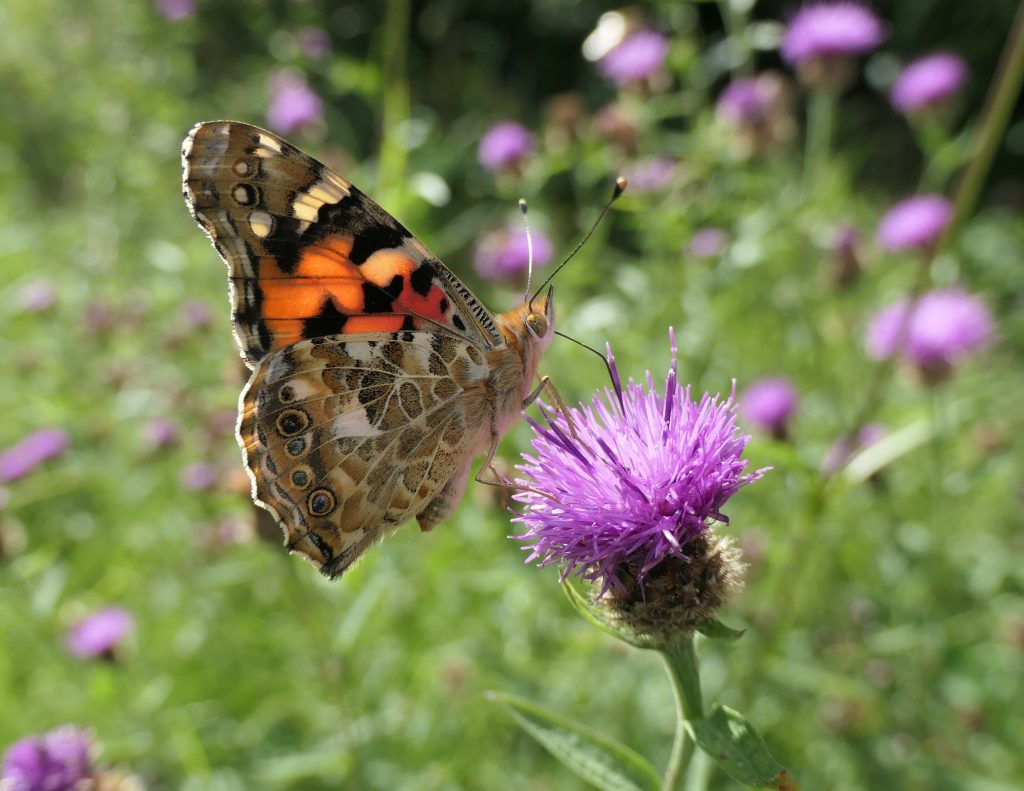 The Painted Lady was seen from 6 March to 15 December. It was the last butterfly reported in 2025.
We learned of the first Speckled Wood on 31 March when Frank Smyth saw one in Howth, one of the driest, warmest places in Ireland. April 2 was a beautiful spring day, marked by the first Orange-tip, from Lullybeg, Kildare, spotted by Pat Wyse, and Small Whites (Sutton, Frank Smyth, Patricia Daly, Nore River Walk, Kilkenny). Eamonn McGlinchey and Maurice Simms recorded the first Green-veined Whites in Letterkenny and Portnoo, Donegal, on 6 April. On 11 April, the first Large Whites were sighted (Summerhill Forest, Denise and Jesmond Harding). April 29 saw the first Small Copper from Dunfanaghy, Co. Donegal (Eamonn McGlinchey). In 2024, the first waited until 19 May, 20 days later. As can be seen, weather conditions can exercise a considerable influence over butterfly emergence times.
There was a large increase in records in early April, with the consistent sunshine since early March coaxing spring-hatching butterflies from their pupae.
Would this result in early hatching for species we often first record in late April or even mid-May? Yes, it did, for the first Dingy Skipper was noted on 12 April (Sheskinmore, Donegal, by Maurice Simms) and the curtain was raised on the Cryptic Wood White on 28 April, at Cloondaver, Lough Carra, Mayo, by Geraldine Nee. While this is not especially early for the Cryptic Wood White, in 2024 it was not seen until 10 May. These are single-brooded butterflies in Ireland, flying mostly in May and June. The early emergence of these species might encourage a second brood to fly. If the summer was warm enough, would the diapausing * pupa (Cryptic Wood White) and caterpillar (Dingy Skipper) end their dormancy and develop directly, without overwintering?
Another big surprise arrived on 8 May when Jesmond Harding counted 15 Marsh Fritillaries at Lullybeg. This equals the earliest record of this butterfly. It is possible the butterfly on the site hatched before this date, especially as 15 were recorded. The development of the vegetation and numbers and species of Lepidoptera and Odonata on the wing were more typical of the end of May. In 2024, the first Marsh Fritillaries were reported on 19 May, from Lullybeg. In 2025, nature pressed the fast-forward button!
The earliest Wall butterflies were seen on 1 May (Rosbeg and Sheskinmore, Donegal, by Maurice Simms and Inishbofin, Galway, by John Lovatt). The first Small Heath was also recorded on 1 May, by Maurice Simms, in the beautiful Sheskinmore Reserve, 18 days earlier than in 2024. The first Common Blue was also noted on 1 May by Felicity Laws in West Cork (first record on 19 May in 2024). Maurice Simms and Ingrid Grollke reported the first Small Blue on 2 May, in Sheskinmore, Donegal. The Pearl-bordered Fritillary and Wood White were reported first on 16 May (Clooncoose, Clare, by Sean and Luke Geraty, Stephen Bolger). The second brood of Wood White was reported on 31 July (Conor O’ Byrne, Ballyvaughan, Clare), where it was abundant. The first Green Hairstreaks were reported on 10 April (Coolboy, Letterkenny and Ballyare Wood, Ramelton, Donegal, seen by Eamonn McGlinchey) and the final one reported in 2025 was in Killyconny Bog, Cavan, seen by Jonathan Shackleton, on 10 June.
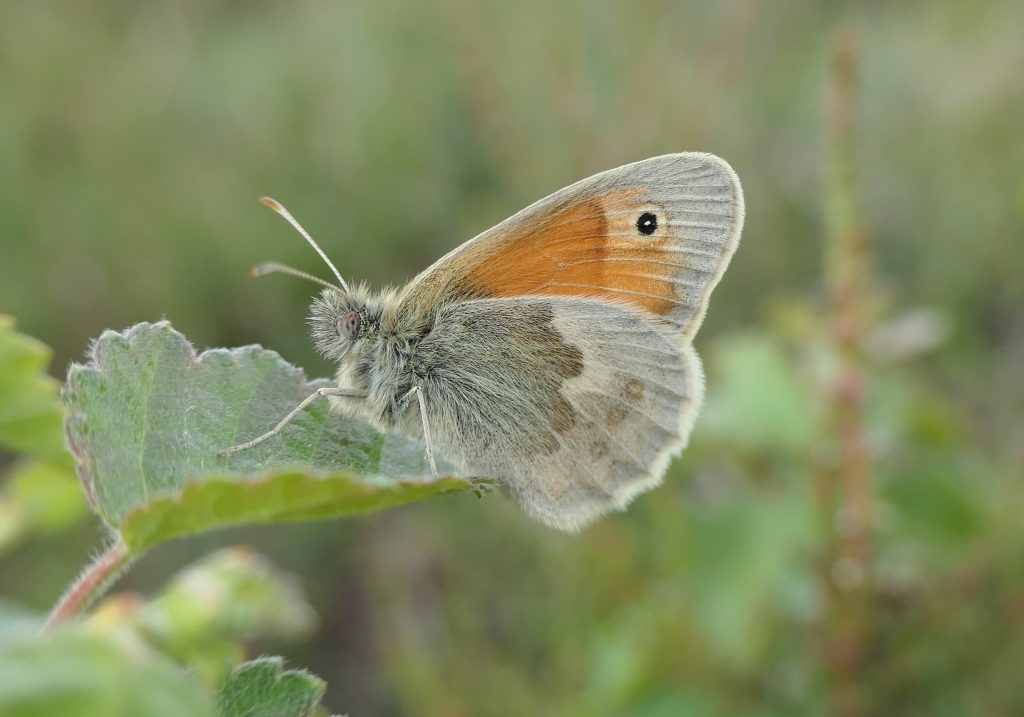 The Small Heath has suffered serious declines in recent years.
These are mostly spring flying butterflies, although most extend their flight periods into summer, and those that have more than one generation reappear on the wing later in the year. Most summer species emerged earlier than is typical. Sean Geraty saw the first Purple Hairstreak on 9 July, in the Phoenix Park, Dublin, a day later than the first report of his tree-dwelling butterfly in 2024. The Dark Green Fritillary was seen first by Jonathan and Daphne Shackleton, near Cahercommaun Fort, Clare, on June 7, the same date as the first Ringlet (Jesmond Harding, Lullymore, Kildare). The first dates for Dark Green Fritillary and Ringlet in 2024 were 25 June and 12 June, respectively. The Silver-washed Fritillary, a woodland butterfly, appeared first on 21 June, Kilfeighny, Co. Kerry (Kay O’ Leary). In 2024, it was not reported until 16 July. Meadow Brown appeared first on 28 May (Jonathan Shackleton, Mullagh, Cavan). Large Heath was first sighted on 31 May, in Clara Bog, Offaly, by Sean and Luke Geraty. These are early dates for all these species.
Con O’Donnell reported Graylings on 22 June in Doagh Isle, Ballyliffin, Inishowen, Co. Donegal, where Con counted over 70 Dark Green Fritillaries, feeding mostly on Bramble. On 20 June, Small Skippers were found on Drehid Bog by Jesmond Harding (in 2024, the first were seen on 8 July). Its confusion species, the Essex Skipper, was reported first on 9 July at Ballyknock, Kilkenny, by Robert Donnelly (16 July in 2024). The Brown Hairstreak, usually the last single-brooded butterfly to emerge, was first seen on 31 July, in the Burren National Park, by Helen McQuillan. This elusive butterfly had a good year in the area, to judge by the number of eggs Jesmond Harding found on 22 August.
How the weather in 2025 influenced butterfly brood structures
The year showed how early our butterflies can emerge under conditions of prolonged warmth. However, the year threw up some other major surprises. A butterfly that has never been known to produce a second generation in Ireland did so in 2025; the Dingy Skipper, a spring flyer, produced a small second generation in August 2025, to the amazement of seasoned observers. This historic development is likely the result of the high levels of warmth, sunshine, and moisture during March-August.
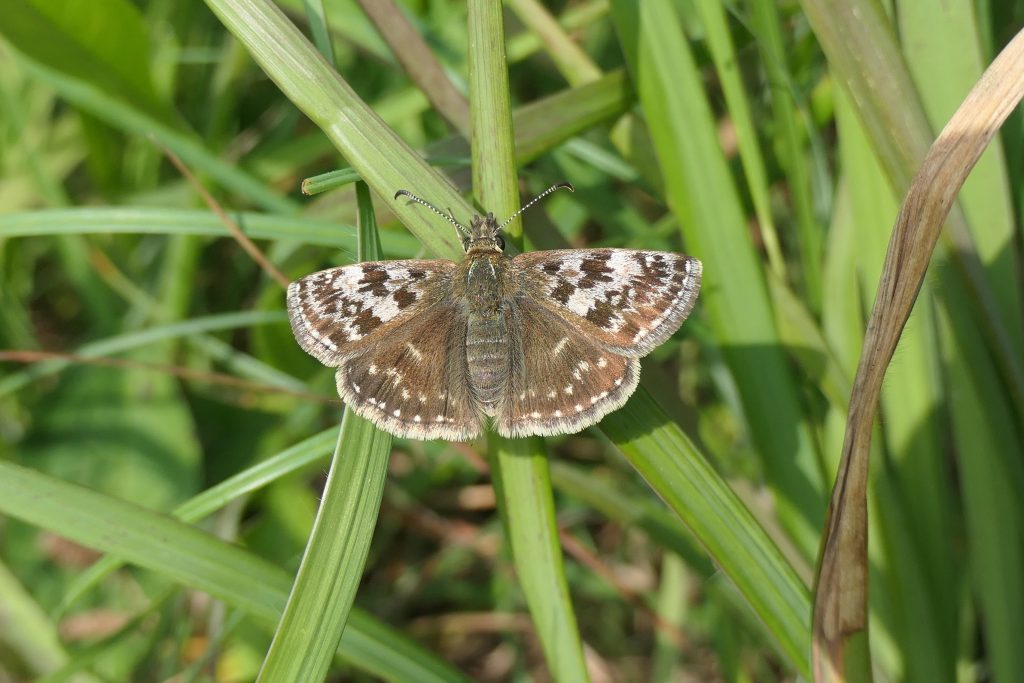 This second brood female Dingy Skipper was seen in August.
The Cryptic Wood White has proved single-brooded in Ireland. It flies mainly from May to mid-July. Before 2025, only one was reliably recorded several weeks after its flight period ended; this was on 2 September 2020 in Mulhussey, Meath, by Jesmond Harding. The recording of Cryptic Wood Whites in a few locations in Northern Ireland and Inishowen Head, Donegal (Con O’Donnell, 30 July and 9 August) and Killyconny Bog track, Cavan (Jonathan Shackleton, 27 July) in late July and early August is hard to explain. The tendency by butterfly species to produce a second generation in Ireland is higher further south, but only one Cryptic Wood White was seen in the south of Ireland (Kildare) in late July.
Another great surprise was the sighting of a single Small Blue, by Maurice Simms, on 24 August, in Castlegoland, Portnoo, Donegal. This single male was seen eight weeks after the last record of the species was reported from SW Donegal.
These sightings might indicate the future for butterflies known to be single-brooded in Ireland. The flexibility/plasticity of the voltinism (brood structure) of some species underlines the ability of butterflies to respond to environmental changes, in this case, temperature and probably, increases in direct sunshine. This highlights the need to continue recording our butterflies.
Butterflies that are known to produce more than one generation per year responded to the warmth by extending their flight periods by producing a third generation. The Small Copper produces two broods every year, with a clear gap between the first and second generations. In 2025, the first generation’s recorded flight period lasted from 29 April to 18 May. The second brood was first recorded on 1 July. This overlapped with a third generation that was last seen on 19 October.
Conclusion: Did Ireland’s butterfly populations increase in 2025?
Before concluding this year’s report, what indication is there that populations increased in 2025? In 2024, we had 30 reports of one or more Small Coppers; in 202,5 there were 71 reports of this butterfly. The highest number of Small Coppers recorded on a site in 2025 was 16, followed by 14. In 2024, 10 was the highest number seen; the second highest was just three. In 2024, there were 76 reports of the Comma, and 73 reports in 2025. However, the highest number of Comma recorded in one site in 2025 was 23; it was 16 in 2024. The Small Tortoiseshell was reported 130 times and 153 times in 2024 and 2025, respectively. The highest number of Small Tortoiseshells reported in 2024 was 12; in 2025, it was 68. However, in some areas, few or no Small Tortoiseshells were seen in 2025. The recovery from the losses in 2023 and 2024 remains incomplete. Our populations remain in crisis.
* Diapause: a time of suspended development, usually in response to environmental cues signalling the onset of unfavourable conditions. This is genetically determined, and change in the capacity to enter diapause and its timing can be driven by natural selection (the core mechanism of evolution where organisms better adapted to their environment are more likely to survive, reproduce, and pass advantageous, heritable traits to offspring, leading to gradual changes in populations over generations) and segregating genetic variation (where offspring inherit different versions/unique combinations of a gene from their parents).
CRABTREE RESERVE REPORT 2025 by Jesmond Harding
| Species Recorded | 2019 | 2020 | 2021 | 2022 | 2023 | 2024 | 2025 |
| Dingy Skipper | 10 | 10 | 47 | 31 | 21 | 14 | 31 |
| Brimstone | 102 | 52 | 47 | 44 | 129 | 50 | 55 |
| Cryptic Wood White | 9 | 6 | 6 | 1 | 0 | 1 | 1 |
| Green-veined White | 6 | 7 | 10 | 14 | 20 | 4 | 30 |
| Orange-tip | 7 | 2 | 1 | 1 | 1 | 0 | 4 |
| Large White | 0 | 2 | 2 | 1 | 1 | 0 | 7 |
| Small White | 4 | 2 | 3 | 2 | 0 | 2 | 1 |
| Green Hairstreak | 0 | 1 | 0 | 0 | 0 | 0 | 0 |
| Common Blue | 44 | 36 | 31 | 18 | 32 | 18 | 15 |
| Holly Blue | 0 | 1 | 0 | 0 | 1 | 1 | 0 |
| Small Copper | 15 | 20 | 13 | 12 | 5 | 4 | 17 |
| Red Admiral | 65 | 13 | 2 | 93 | 101 | 2 | 176 |
| Painted Lady | 260 | 0 | 2 | 1 | 3 | 1 | 20 |
| Small Tortoiseshell | 206 | 231 | 270 | 134 | 517 | 8 | 101 |
| Peacock | 319 | 48 | 39 | 17 | 239 | 6 | 129 |
| Comma | 1 | 0 | 0 | 21 | 11 | 0 | 15 |
| Dark Green Fritillary | 27 | 21 | 11 | 2 | 4 | 0 | 0 |
| Silver-washed Fritillary | 28 | 9 | 6 | 8 | 57 | 1 | 22 |
| Marsh Fritillary | 80 | 163 | 287 | 206 | 247 | 195 | 133 |
| Wall | 0 | 1 | 1 | 0 | 0 | 0 | 0 |
| Speckled Wood | 35 | 11 | 7 | 19 | 22 | 11 | 16 |
| Meadow Brown | 401 | 204 | 417 | 206 | 264 | 288 | 130 |
| Ringlet | 1423 | 588 | 1097 | 636 | 1296 | 1276 | 1422 |
| Small Heath | 57 | 44 | 74 | 35 | 52 | 38 | 24 |
| Large Heath | 0 | 0 | 0 | 1 | 0 | 0 | 1 |
| Total | 3099 | 1472 | 2373 | 1514 | 3023 | 1920 | 2349 |
The butterflies on Butterfly Conservation Ireland’s Crabtree Reserve at Lullybeg are counted by walking the transect route (a fixed route walk through habitats that represent those found on the reserve) on part of the reserve from April to the end of September and in October when conditions favour butterfly activity. Results are sent to the National Biodiversity Data Centre for the Irish Butterfly Monitoring Scheme.
Butterflies seen outside the transect route are counted separately, but the table above gives combined figures to give the site total (note: only managed areas of the site are surveyed). In 2021 and 2022, 21 counts were made; in 2023, 24 counts were made; in 2024, 22 counts were made; in 2025, 24 visits were made. Twenty-one species were seen on the reserve in 2025.
The total number of butterflies seen is 2,349, 429 higher than the 2024 total. The total decline in butterflies recorded between 2023 and 2024 is 63.5%. The increase is not attributable to the two extra visits. The increased abundance figures are mostly due to the rise in the populations of the Small Tortoiseshell and Peacock butterflies, which can produce large populations when conditions favour them. For example, 2024 saw an abject performance in the Peacock, with a mere six counted, but 129 were recorded in 2025. Brimstone has not recovered its 2023 abundance. The Silver-washed Fritillary showed in greater numbers locally, going from just one in 2024 to 22 in 2025.
Twelve species showed an increase on the 2024 figures, while only one species increased in abundance in 2024 from 2023, the Meadow Brown (264-288).
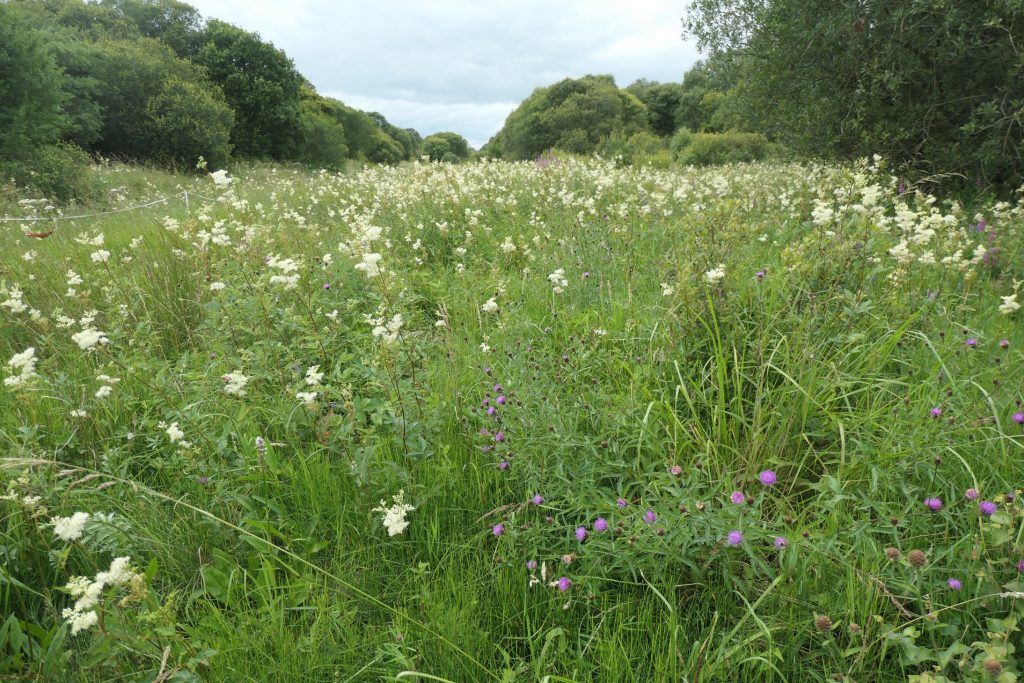 Lullybeg Reserve in mid-summer.
One of the conservation priorities, the Small Heath, declined, falling from 38 to just 24. This is a great concern. There is habitat on an area in the reserve that looks suitable, but the butterfly has not occupied it. The Small Heath is in serious trouble nationally, with the latest available data showing an abundance decline of -79% from 2008-2024.
The reserve was managed in 2025, with scrub control and grazing on the northern side. We extend a special thanks to everyone who helped and supported our work. The reserve would not be the special place it is without the care you have shown; thank you.
CONSERVATION NEWS 2025 by Jesmond Harding
This report deals with some of our work undertaken during 2025. During February 2025, the planned work party cut birch and willow to allow more sunlight to access the grassland at the end of the corridor adjacent to the reserve. This made a great difference to the habitats, particularly for the Marsh Fritillary and Brimstone.
During the November work event, we concentrated on uprooting birch saplings on the northern side of the reserve adjoining the plantation forestry. Individual members undertook some scrub clearance by hand during January and February.
Scrub on the broad corridor ride through woodland connecting Lullymore and Lullybeg was also cut to ensure that the two excellent areas remain linked so that butterfly populations in the area do not become isolated. Machinery cut scrub in the southern part of the reserve and along the silt pond on the northern edge of the reserve, which is used as a feeding area by butterflies. We also arranged grazing in 2025. This took place in September and October and lasted about three weeks. This helped to reduce the sward density on the northern side of the reserve.
Our butterfly recording scheme began in 2013 and has continued. We have thousands of records on our website. These records are high quality, because they come from reliable observers and contain clear information about the species and numbers found, the date and location of the finding, and sometimes additional information about the weather conditions and habitat. New recorders frequently provide photographs of butterflies to support their records. Details of how the process works are here: https://butterflyconservation.ie/wp/records/
These records have contributed to a major publication, An Atlas of Butterflies in Ireland, 2010-2021, published by the National Biodiversity Data Centre in May. Several members of Butterfly Conservation Ireland were involved in writing and editing the Atlas, a tribute to the expertise and commitment of our membership.
The Atlas was published by the National Biodiversity Data Centre with support from Butterfly Conservation Ireland and Butterfly Conservation Northern Ireland. It provides a benchmark against which to measure future population trends, in both distribution and abundance.
The Atlas maps the distribution of all thirty-five butterflies that occur in Ireland, comparing the pre-2010 distribution to the 2010-2021 period. It maps the distribution of each species at the 10 km level and additional maps plot the distribution of three rare species at a finer resolution. The two identical looking wood white butterflies are individually mapped, applying the results of laboratory analysis to confirm species identity.
The Atlas combines data from seven separate datasets applying different recording methodologies that contributed 408,812 records. Accounts for the thirty-five species from 28 authors (16 being Butterfly Conservation Ireland members) describe the appearance, habitat, ecology, distribution map and population status of each species. Abundance trends are provided for the 15 most common butterflies. Summary accounts and maps are presented for five vagrant species. The species accounts are supported by chapters on ‘History of Butterfly Recording in Ireland’, ‘Breeding Habitats for Ireland’s Butterflies’, ‘Background and Data Sources’, ‘The Changing Fortunes of Ireland’s Butterflies’ and ‘Why are Some of Ireland’s Butterflies Declining?’.
Its immediate use is to inform the review of the Red List of Ireland’s butterflies. This review is in progress and publication is expected early in 2026. The five-person panel producing the new Red List consists of the state entomologist Chris Peppiatt from the National Parks and Wildlife Service, Liam Lysaght from the National Biodiversity Data Centre, Jesmond Harding from Butterfly Conservation Ireland, Rose Cremin from Butterfly Conservation Northern Ireland and Pauline Campbell from the Department of Agriculture, Environment & Rural Affairs in Northern Ireland.
Our online platforms promoted conservation throughout 2024. Various blogs were written to draw attention to butterfly and moth species that may be seen at various times of the year, to conservation measures one can take to enhance gardens and public spaces for butterflies, to promote recording, to comment on findings of various reports on butterfly and moth populations and to report on Butterfly Conservation Ireland outings. Our Facebook page presents very attractive images sent in by members and by the public, as well as publicising our work/events. Conservation and habitat enhancement advice was provided to a range of bodies and members of the public.
Four of our members showed an interest in trapping and recording moths. Aided by a grant from The Heritage Council, Moth traps and identification guides were purchased and recording went ahead. All participants have thoroughly enjoyed this adventure. A special thanks to Philip Strickland for leading the training day in June 2025 and for hosting a trapping event in the lovely grounds of his home.
Butterfly Conservation Ireland is deeply concerned by plans to build a large wind farm complex in the Bog of Allen, which includes Lullybeg and Lullymore. We have written to the consultants for the applicant in response to their pre-scoping exercise. The region has outstanding biodiversity and deserves to be a National Park. A website has been launched to support this proposal: https://www.nationalpeatlandspark.com/. We will continue to defend the region, a vital reservoir for biodiversity in a general landscape denuded of nature. We expect a planning application to be made to An Coimisiún Pleanála in 2026. We will keep you informed of any developments.
In October 2024 BCI’s Val Swan and Jesmond Harding met Kildare’s biodiversity officer Meabh Boylan with other conservation groups and interested individuals to make submissions to develop Kildare’s Biodiversity Action Plan. We hoped our input, which included a written submission, would inform the Plan’s priorities. We strongly encouraged the development of a National Peatlands Park based in north-west Kildare and East Offaly.
However, when the Kildare County Council Draft Biodiversity Action Plan 2026-2031 appeared, the contents appeared to be influenced by Bord na Móna and Coillte, the county’s two largest state landholders, which had representatives on the working group that developed the Draft Plan. Butterfly Conservation Ireland responded with detailed observations, which can be viewed on https://consult.kildarecoco.ie/en/consultation/county-kildare-draft-biodiversity-action-plan-2026-2031.
Our submission addresses serious issues of concern in the draft Biodiversity Action Plan. Forty-six submissions from other organisations and individuals were made. We await the results of this process.
Defending nature requires constant work. Much of this is painstaking and tedious, but it is, unfortunately, very necessary. We hope that we continue to have your support for this throughout 2026.
GARDEN SURVEY REPORT 2025 by Jesmond Harding
Introduction
Butterfly Conservation Ireland members and members of the public participate in our garden survey from March to November. The survey form, available as a download from our website at
https://butterflyconservation.ie/wp/wp-content/uploads/2017/12/National-Garden-Butterfly-Survey.pdf
and by post on request to conservation.butterfly@gmail.com asks the participant to record the first date each butterfly listed on the form was first recorded in their garden in each of the following three-month periods: March-May, June-August and September-November. In a final column, the highest number of each butterfly species seen, and the peak date are given. Finally, surveyors are asked to indicate which of the following attractants are provided in their gardens: Buddleia, butterfly nectar plants other than Buddleia and larval food plants. Twenty butterflies are listed for recording, but additional species can be added. The following report comments on the 2025 flight season, outlines the status of these butterflies in gardens during 2025, offers interpretations and comments on the findings and concludes by urging conservation and involvement in recording garden butterflies.
One of the great pleasures of having a garden is seeing nature move in and feed, shelter, rest and breed. It ticks our happiness box, appealing to our sense of creativity and nurturing, and to the increasingly urgent need to conserve our natural world. The grace and beauty of butterflies fulfil these needs more than most creatures. Monitoring the butterflies that visit, counting them, recording the dates that they appear, studying the flowers that attract them most and investigating if and where they lay their eggs adds greatly to a gardener’s enjoyment. If you agree, we’d love you to join our garden survey recording scheme.
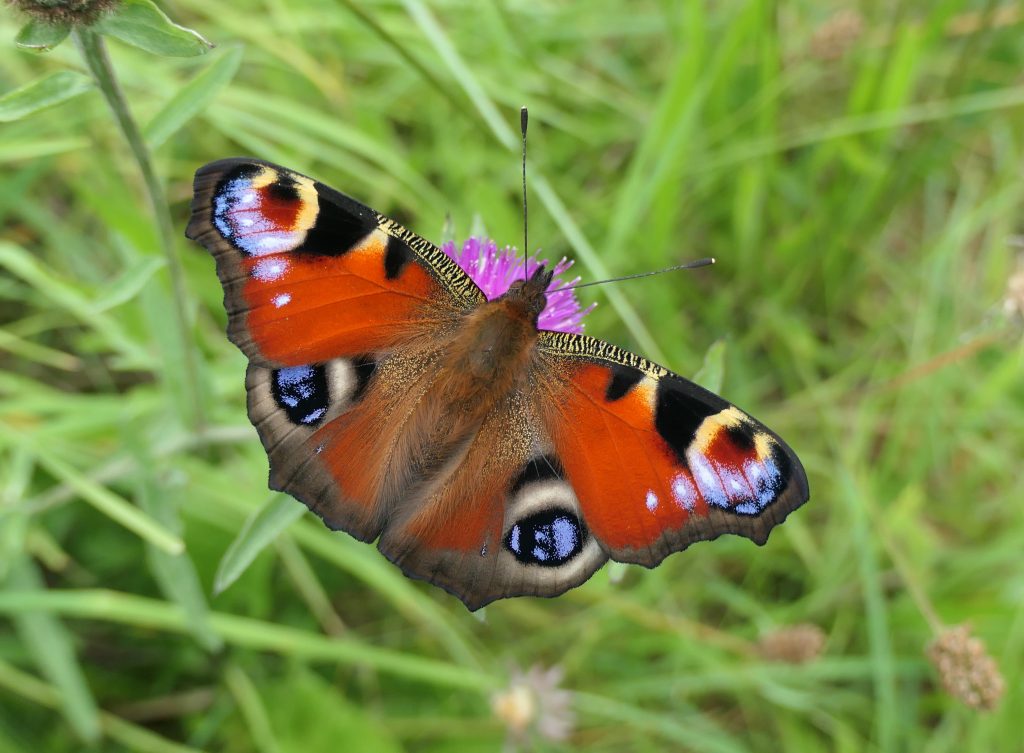 The Peacock was recorded in all gardens, but in low numbers.
Abundance
Abundance plunged during 2024, a terrible year for butterflies, including garden visitors. As you will know, 2025 was much better. Take the Small Tortoiseshell. Robert Donnelly, whose superb rural garden designed for nature is in Ballyknock, County Kilkenny, counted 158 Small Tortoiseshells on August 22, 2023. In 2024, Robert’s Small Tortoiseshell population peaked at just 12, recorded on 9 September 2024. In 2025, Robert recorded a peak of 74 on 12 August. While considerably fewer than his 2023 peak, it is far higher than the nadir in 2024. In fact, only two species exceeded their 2023 peak in Robert’s garden in 2025; these are the Meadow Brown (15 on 18 July) and Ringlet (12 on 26 June). However, Robert Donnelly did not record the Cryptic Wood White in 2025, but he saw five on 23 May 2023 and four on 22 June 2024.
Returning to the Ringlet, the highest count was 16 by Felicity Laws on 2 July. Despite the rural location of Jesmond Harding’s garden, he saw only one Ringlet, on different dates. It will take more than one good year to repair the damage suffered by the prolonged, extreme rainfall from July 2023 to October 2024.
Michael Gray, whose garden is in the Dublin suburb of Rathfarnham, counts all his garden butterflies, allowing for an ‘at a glance’ assessment of the interannual vicissitudes. Here are his figures for 2020-2025. 2020: 119; 2021: 115; 2022: 125; 2023: 212; 2024: 105; 2025: 157. It is interesting to note that the population patterns during 2023-2025 in Michael’s garden reflects that in Robert’s garden. These show a high point reached in 2023, a collapse in 2024 and a partial rebuild in 2025.
Peak Large White numbers of 13 on 2 August in Robert’s garden is impressive. Pat Bell had 6 on the same date as well as on two dates in September in his Maynooth garden. Elaine Mullins, from Portmarnock, County Dublin had two as her peak count in 2025. Michael Gray had 25 over the recording period in 2025, higher than 2024’s 17. Interestingly, Felicity Laws in rural West Cork had single Large Whites; in some rural areas, the butterfly is uncommon unless brassicas are grown. Jesmond Harding’s rural Meath garden had a peak of four on two dates in July and one in September. Gardens near Jesmond’s home have garden nasturtium, a breeding plant for this species.
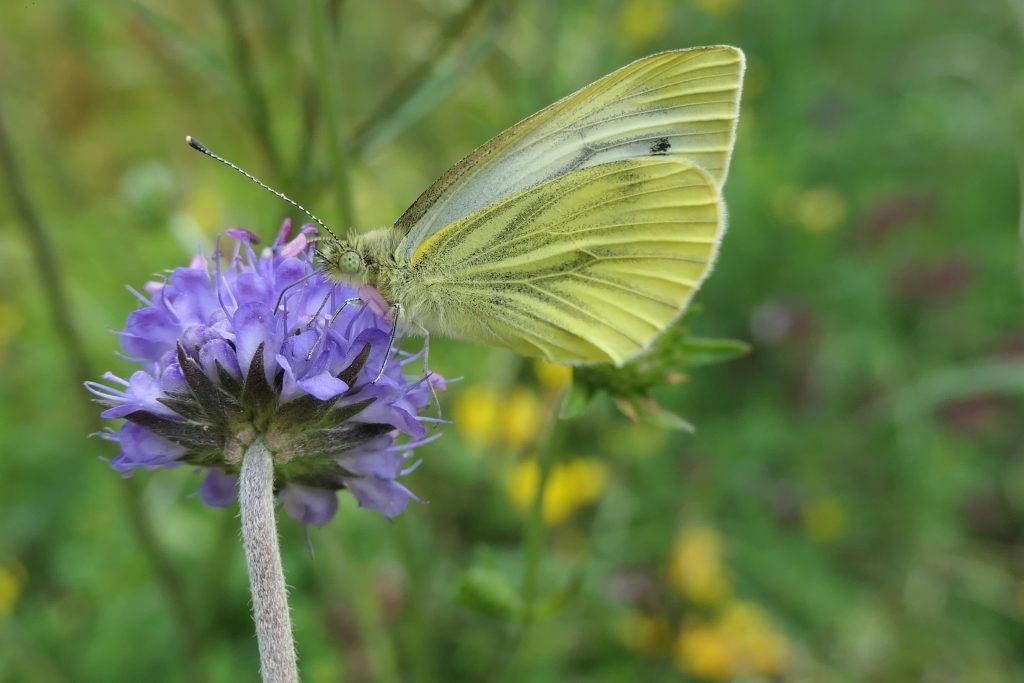 The Green-veined White is one of Ireland’s best distributed butterflies.
The Green-veined White is a frequent visitor to gardens with unshaded damp grassland, especially in rural gardens. Robert’s highest record was 12 on 25 July; this was the same peak reached in 2023 up from a peak of nine in 2024. Jesmond Harding saw nine on 17 August, Felicity Laws found 13 Green-veined Whites on 21 August. Pat Bell, from Maynooth and Kieran Buckley, from Newbridge, County Kildare had low numbers of the butterfly, while Elaine Mullins, Portmarnock, saw none. This accords with the suburban setting of these gardens.
How widespread butterflies featured in our gardens in 2025
The following butterflies were recorded in all gardens surveyed: Large White, Red Admiral, Small Tortoiseshell and Peacock.
There were good numbers of some of these ubiquitous species. In her lovely Kerry garden, Marilyn Farrell counted 53 Large Whites, 79 Red Admirals and 69 Speckled Woods. Marilyn also counted 54 Green-veined Whites.
The Small Tortoiseshell showed in much healthier number during 2025. Pat Bell saw 26 individuals on three dates, 9 and 12 August and 21 September.
Nowhere was there any garden reporting a high number of the Peacock, despite being recorded in all gardens. Thirteen on 12 August was the highest (Robert Donnelly, Kilkenny). Pat Bell, Maynooth had six on 29 July and 12 August.
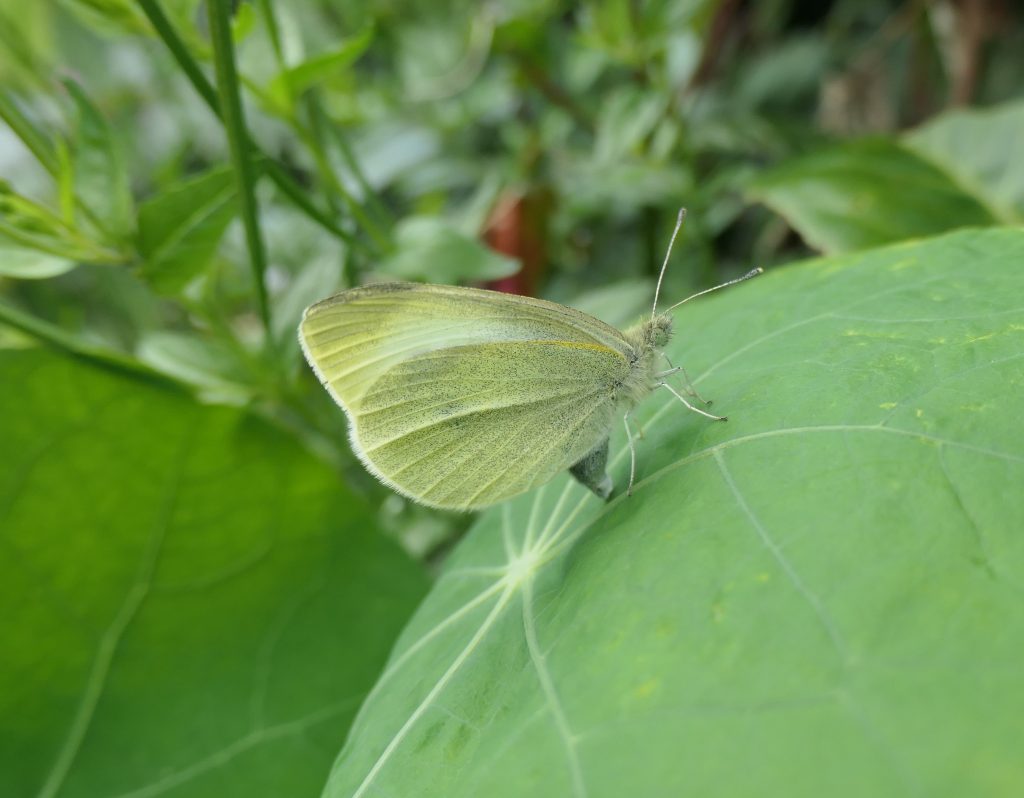 Small White laying an egg on garden nasturtium.
The Green-veined White and the Speckled Wood were found in all but one garden; the Small White appeared in all but two gardens. The Small Copper, while by no means ubiquitous, appeared in most gardens, a sign that it had a good year. It was recorded in gardens from 29 April (Felicity Laws, West Cork) to 19 October (Philip Strickland, Maynooth). The Holly Blue loves gardens, favouring warm rural gardens if they are near semi-natural woodland and virtually any sunny urban garden with Holly or Ivy. No garden returned any third brood Holly Blue, and it did not appear to do well in 2025, in or beyond gardens. An indication of its low abundance is the drop in Michael Gray’s garden from 57 in 2024 to 27 in 2025.
The Common Blue was less well represented in our gardens, and it has suffered serious declines nationally over the last 13 years. The Comma appeared in all gardens within its current Irish range and has been recorded breeding in gardens; Alasdair MacDonald found a female Comma on nettles in his Kilburry West garden in County Tipperary, on 6 April. Looking at the dates when it was recorded, it is clear it has had two broods during 2025. It appeared in every month from March to September. It was not seen in any garden during October or November, but it was seen elsewhere during these months.
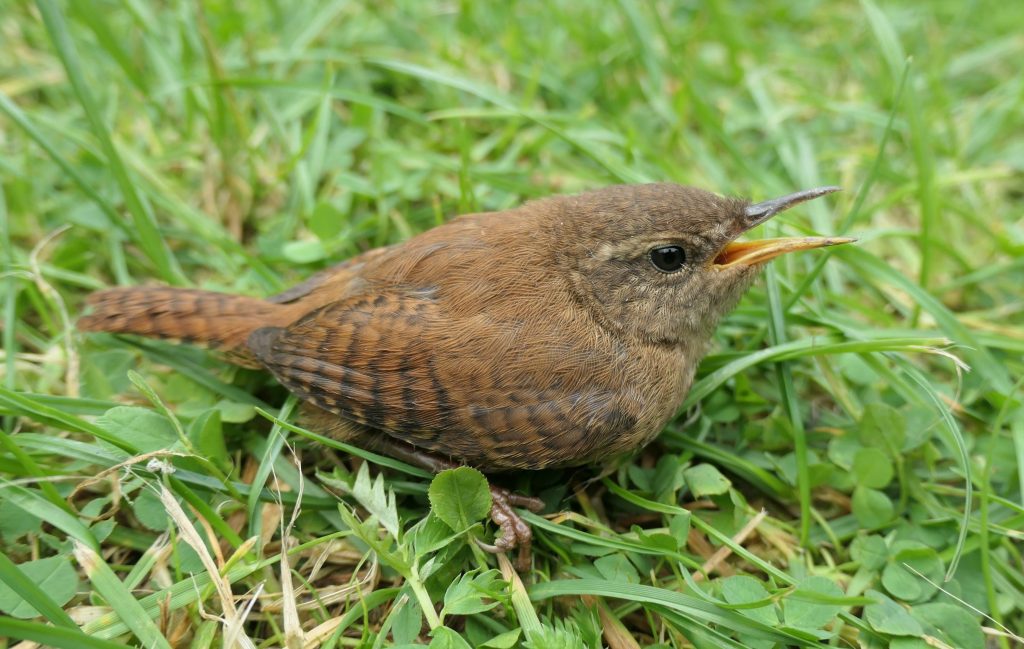 Wrens are major predators of adult butterflies in gardens. This one attacked my Small Tortoiseshells and Peacocks.
Key dates
Reviewing the dates provided by surveyors, there is no agreement on peak abundance dates. The long period of good weather during the summer and at times during September probably meant that abundance was well distributed during July, August and September.
Some recorders had high numbers of butterflies on different dates. Take the example of Maurice Simms, with his butterfly-friendly garden at Combermore, Lifford, County Donegal. On 26 August, he recorded 40 butterflies: Large White 1, Small White 1, Green-veined White 11, Red Admiral 17, Painted Lady 1, Small Tortoiseshell 8, Speckled Wood 1.
On 16 July, Jesmond Harding recorded the following in his rural Meath garden: Large White 2, Small White 1, Green-veined White 3, Holly Blue 1, Red Admiral 1, Peacock 1, Comma 1, Speckled Wood 1, Meadow Brown 2, Ringlet 1(14 individuals, 10 species).
The significance lies in the range of foodplants used by these butterflies. The Large and Small Whites breed on wild and cultivated brassicas, Green-veined White needs wild brassicas, Holly Blue needs Ivy (summer), Red Admiral, Small Tortoiseshell, Peacock and Comma need Stinging Nettle, Painted Lady needs thistles, while wild grasses are needed by the Speckled Wood, Meadow Brown and Ringlet, but each requires a distinct grassy niche. The presence of a range of butterfly species can indicate the diversity of the garden habitats. It must be stated that the presence of these species does not establish breeding, but all these species will breed in gardens if you provide suitable conditions.
The earliest and latest garden butterflies in 2025
The first butterfly recorded in 2025, a Small Tortoiseshell, was seen by Robert Donnelly on 2 March. The first butterfly seen that does not pass the coldest months in the adult state is a Green-veined White seen on 3 April by Robert Donnelly. The last garden butterfly seen in 2025 was a Speckled Wood on 31 October, by Jesmond Harding. Interestingly, on 19 October, a particularly beautiful autumn day, Robert Donnelly’s garden returned five species: Green-veined White 1, Red Admiral 3, Painted Lady 1, Small Tortoiseshell 3, Speckled Wood 1. This is impressive, this late in the year. Helen Cloney saw Red Admiral, Peacock and Comma on 20 March in her Wexford garden. Seeing three species in the garden so early is noteworthy.
Number of species recorded during 2025
The number of species recorded in the gardens surveyed during 2025 was 21, in 2024 it was 20; in 2023 it was 18, 19 in 2022, 17 in 2021 and 2020 and 18 in 2019 and 2018. The total of 21 butterfly species is up from 15 in 2017, 14 in 2015 and 2016 and 17 in 2014. The counties represented are Carlow, Cork, Donegal, Dublin, Kerry, Kildare, Kilkenny, Meath and Wexford.
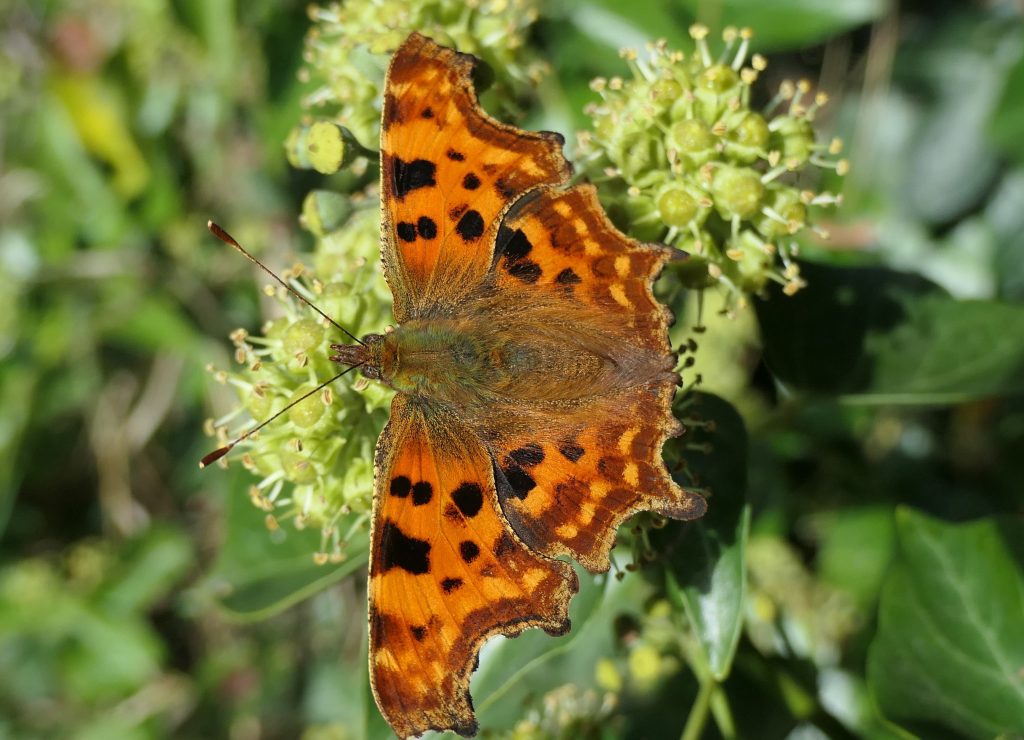 The Comma is now breeding in Irish gardens.
Unusual garden visitors
The Brimstone is considered a garden butterfly in much of southern England and in many parts of Europe, but it is a garden rarity in Ireland. However, it appeared in two gardens, in Kieran Buckley’s garden in Newbridge and Jim Galloway’s garden in Ladystown, Rathvilly, County Carlow, on 12 August. The Brimstone is extremely rare in Carlow. An Atlas of Ireland’s Butterflies 2010-2021 shows it in a single 10 km square in the county.
Only one garden returned records of the Cryptic Wood White. This was Jesmond Harding’s; it was recorded between May 13 and June 13.
Another garden rarity, the Silver-washed Fritillary, featured in a garden in Kay O’Leary’s rural garden in Kilfeighny, County Kerry. There is woodland nearby. Robert Donnelly’s garden received three individuals on 28 July. Three rare visitors appeared in one garden; Felicity Laws received the Clouded Yellow (14 August), Small Heath (13 May) and Hedge Brown/Gatekeeper; Felicity had five of these rare butterflies on 21 July.
Thank you
Special thanks to all our garden butterfly surveyors on whose data this report is based. Our gardens provide important places for our butterflies, which are only attracted to gardens that contain the resources they need. Without your help, your local butterflies might be under even more pressure than they are. You might be persuaded that those common, widespread butterflies using your garden are attractive but not especially noteworthy from a conservation viewpoint. Everyone who gardens for nature must know that our commonest butterflies are under the greatest pressure. The data shows that our widespread, mobile butterflies are in serious decline.
This includes all the common white butterflies, all the common brown butterflies, the Common Blue, Small Copper and Small Tortoiseshell. The lovely Ringlet, a species of tall, humid, lightly shaded grassland, has declined by -78% since 2008 (Judge and Lysaght, 2025). This pushes it very near the Critically Endangered category under the criteria for population size drawn up by the International Union for the Conservation of Nature (IUCN). In my garden, the numbers have dropped over the last decade from a peak count of nine to one. The searing loss of common butterflies impoverishes their ecosystems and the lives of all of us who love beauty.
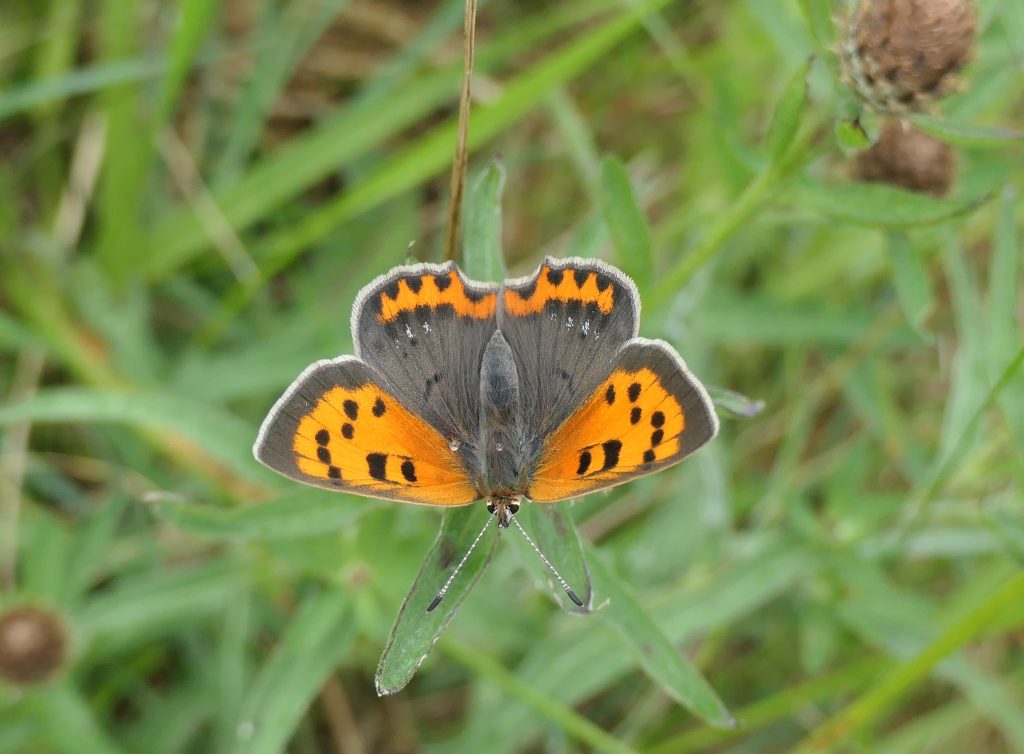 Small Coppers like large gardens and will set up long-term territories in suitable gardens.
Reference
Judge, M and Lysaght, L (2025) The Irish Butterfly Monitoring Scheme Newsletter Issue 17. The National Biodiversity Data Centre.
MUCH ABOUT MOTHS by Jesmond Harding
This is a Did you Know? article.
Some Figures
Ireland has 1505 moth species. 976 occur in the Burren, of these 429 are macro-moths (Checklist of Burren Lepidoptera, 2024).
About 11,500 insects are known to occur in Ireland. Moths make up 13% of all Ireland’s insects.
581 macro-moths (larger moths) occur in Ireland.
95% of macro-moths are nocturnal.
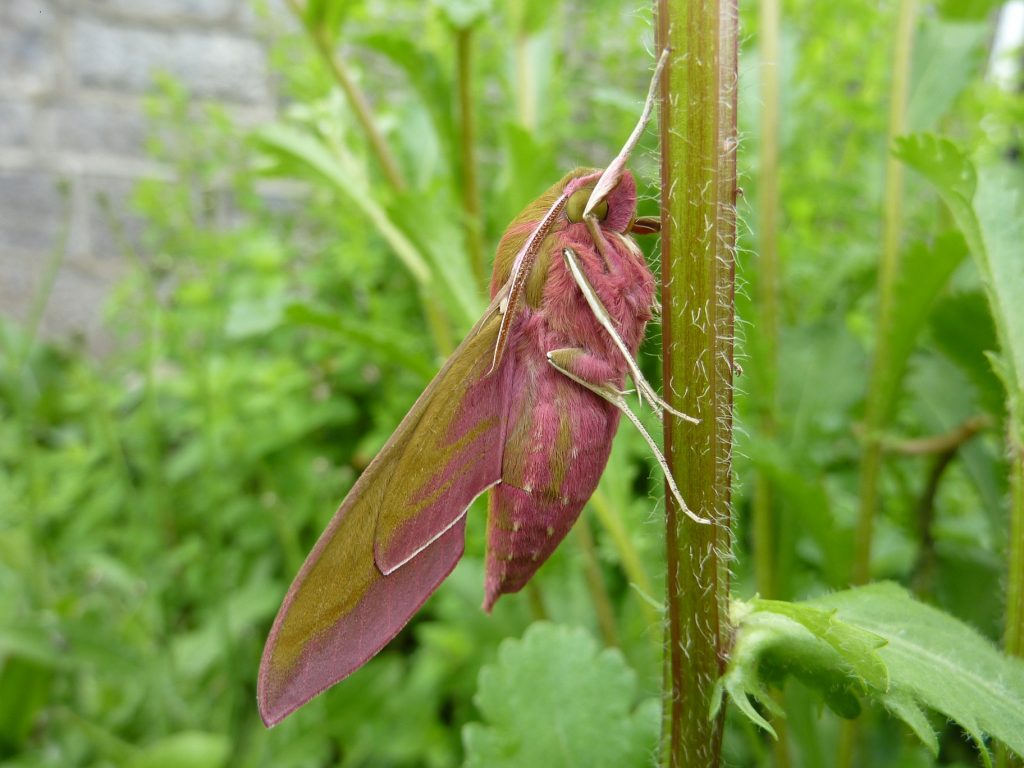 The Elephant Hawkmoth has increased in abundance.
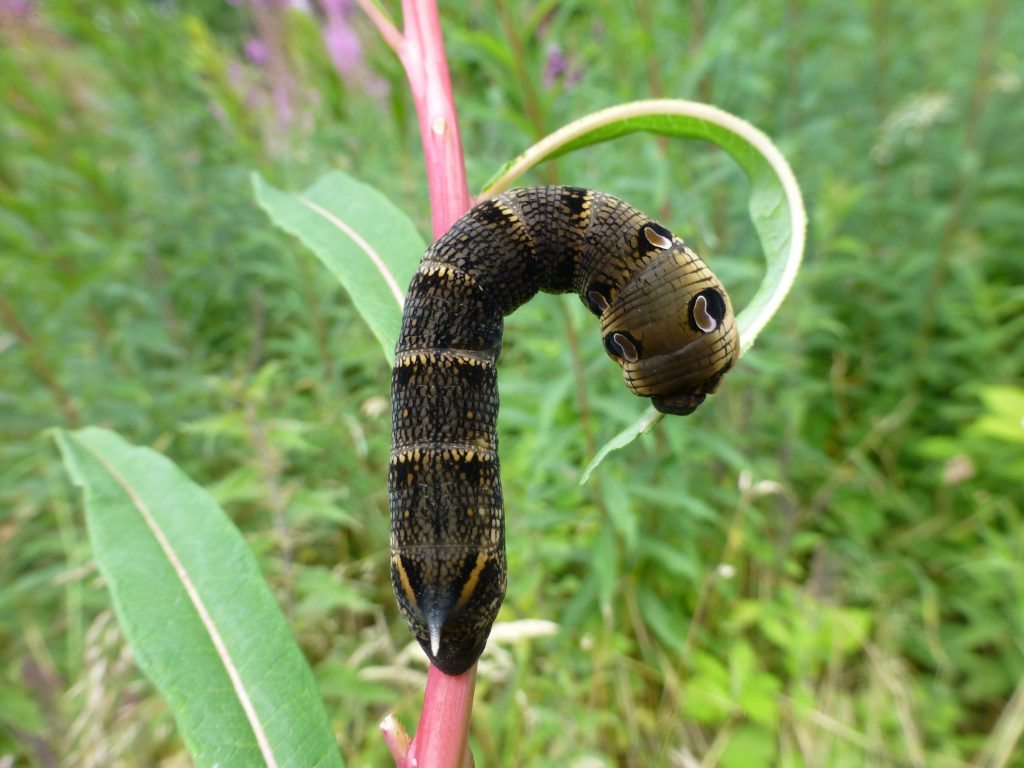
Moth Ecology
Some moth larvae live under water (China-mark moths), some live in the soil (ghost moths), some live within trees (Goat Moth), some live on trees, feeding on the leaves (Poplar Hawkmoth), in grassland (Small Elephant Hawkmoth), some within leaves (leaf miner moths).
Almost all moth larvae feed on live or decaying plant material, not clothing.
Most macro moths are found in and around woodland.
117 macro moths feed on native willows, 104 feed on birches, and some of these feed on both trees/shrubs.
Oak feeds 85 macro-moths, Hazel supports 73. Grow native trees!
Many adult moths are unable to feed.
Some female moths are flightless, having reduced wings or none. They wait for males to find them. Following mating, they lay their eggs and die, without moving from their hatching site.
Moth Conservation Status
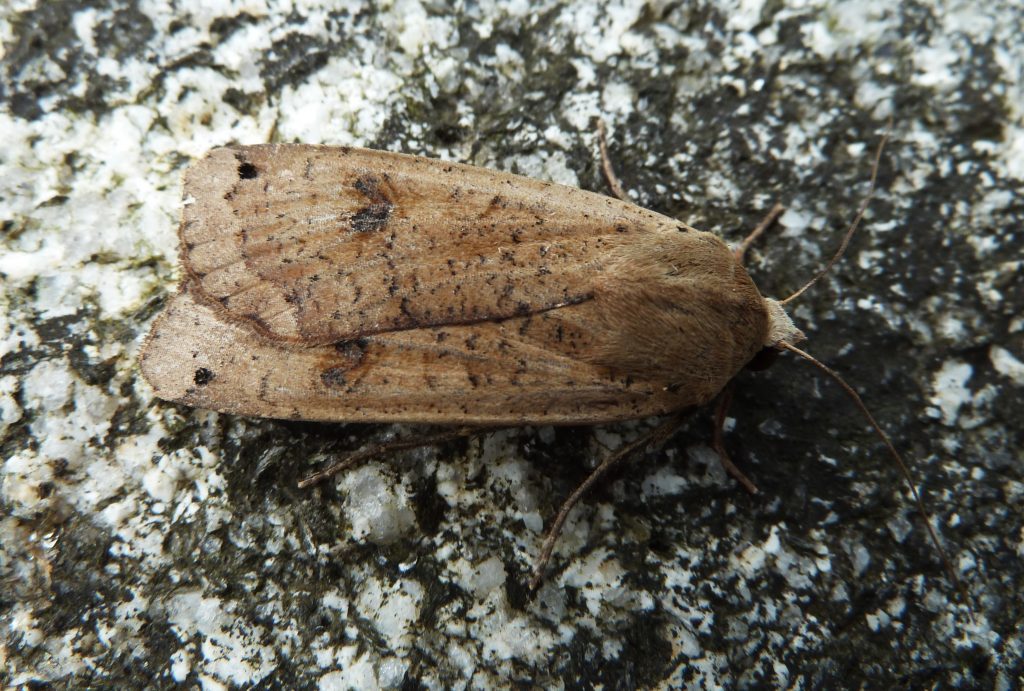 Large Yellow Underwing, which is a resident and migrant, is the most abundant moth in Irish gardens.
Some Irish macro moths are endemic subspecies, occurring nowhere outside Ireland: Irish Annulet, Mere’s Pug, Burren Green, White Prominent, possibly Belted Beauty.
The moth red list published in 2016 assessed the conservation status of Ireland’s moths.
Forty-three species of Irish macro-moth are assessed as threatened, which is 8% of the current Irish list, with another 24 (4%) assessed as Near Threatened or Data Deficient.
Fourteen species of macro-moth are considered to have become Regionally Extinct as they had not been recorded in the 50 years before 31 December 2012.
Of the 43 species assessed as threatened, eight are Critically Endangered, 10 are Endangered, 26 are Vulnerable, and 20 are Near Threatened.
The rest, nearly 84%, are assessed as Least Concern.
Since the list was published, one of the species assessed as Vulnerable, the Narrow-bordered Five-spot Burnet, has greatly increased its distribution or is better recorded, or both. The Garden Tiger, then assessed as Least Concern, appears to have suffered a reduced distribution.
A citizen science initiative run throughout Britain and Ireland monitors garden moths. The purpose of the Garden Moth Scheme (GMS) is to try to find out what is happening to our common garden moths. The results for 2008-2023 were published in 2025.
The main GMS runs for 36 weeks from March-October each year. In the results analysis, 178 species, including 9 micro-moths, are included in the figures.
Over the period 2008-2023, 52% of species increased and 48% declined. Species that declined include Garden Tiger, Clouded-bordered Brindle, Beautiful Golden Y and Dot Moth. Species that showed increases include Lunar Underwing, Elephant Hawkmoth, Beaded Chestnut and Centre-barred Sallow.
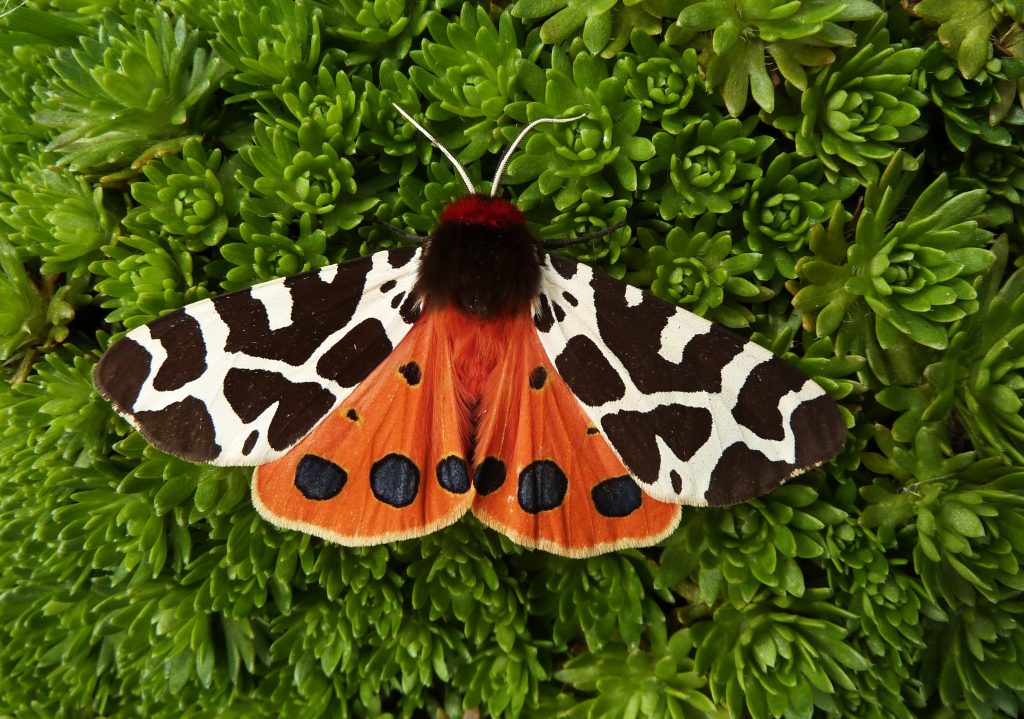 The Garden Moth Scheme shows the Garden Tiger is declining.
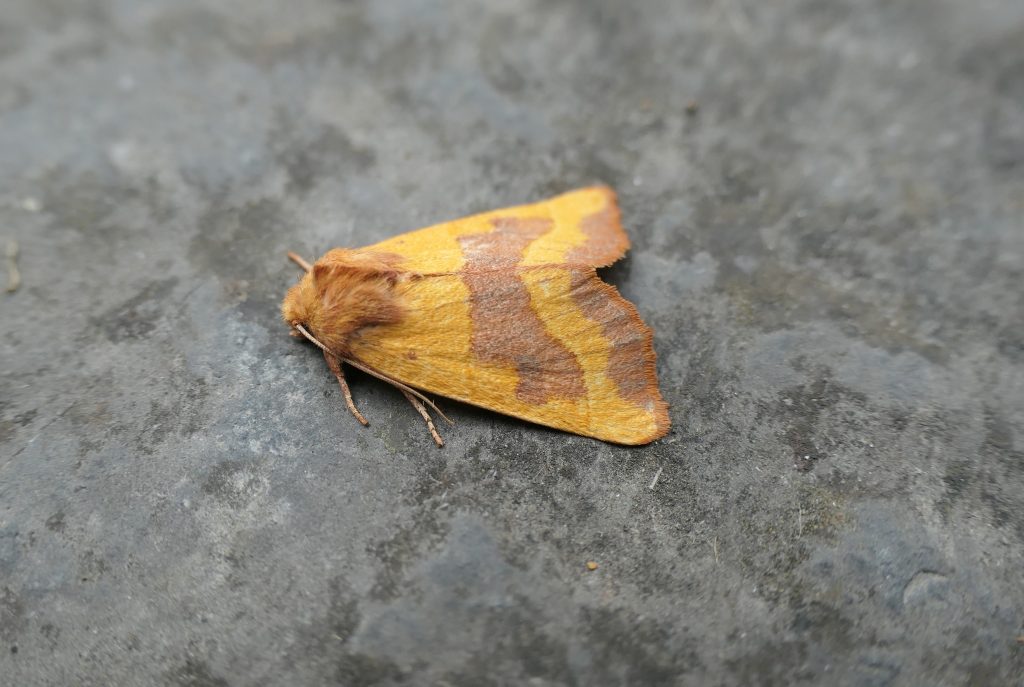 The Centre-barred Sallow is an autumn flying moth that has shown increases since 2008.
The most abundant moth in Irish and British moth traps 2008-2023 is the Large Yellow Underwing, with 911,008 individuals. A distant second is Heart and Dart (401,460), third is Dark Arches (236,203), fourth is Setaceous Hebrew Character (231,697). The most numerous moth species trapped in winter is the December Moth, with 7,404 individuals.
Importance of Moths
Moths play a significant role as herbivores, as pollinators and as prey items for birds and bats. Many other insects, especially in the Hymenoptera (sawflies, wasps, bees, ants) and Diptera (flies), parasitise species of Lepidoptera. Some individual moth species lay hundreds of eggs, producing hundreds of caterpillars, providing a large volume of the food needed to feed these birds, bats and insects. An indication of this important abundance is gained from inspecting a moth trap in a summer garden, when over 100 individual Large Yellow Underwings can be found.
On 2 August 2025, 198 Large Yellow Underwing adult moths were counted in my moth trap, a great food resource for many birds and bats. Nectar-feeding moths are good pollinators, bringing their hairy bodies in intimate contact with pollen as they feed. Their presence in such a range of habitats adds to their importance, not simply because they contribute to the habitat in which they occur, but because some species spend different parts of their life cycles in very different habitats, these are contributing to different ecosystems.
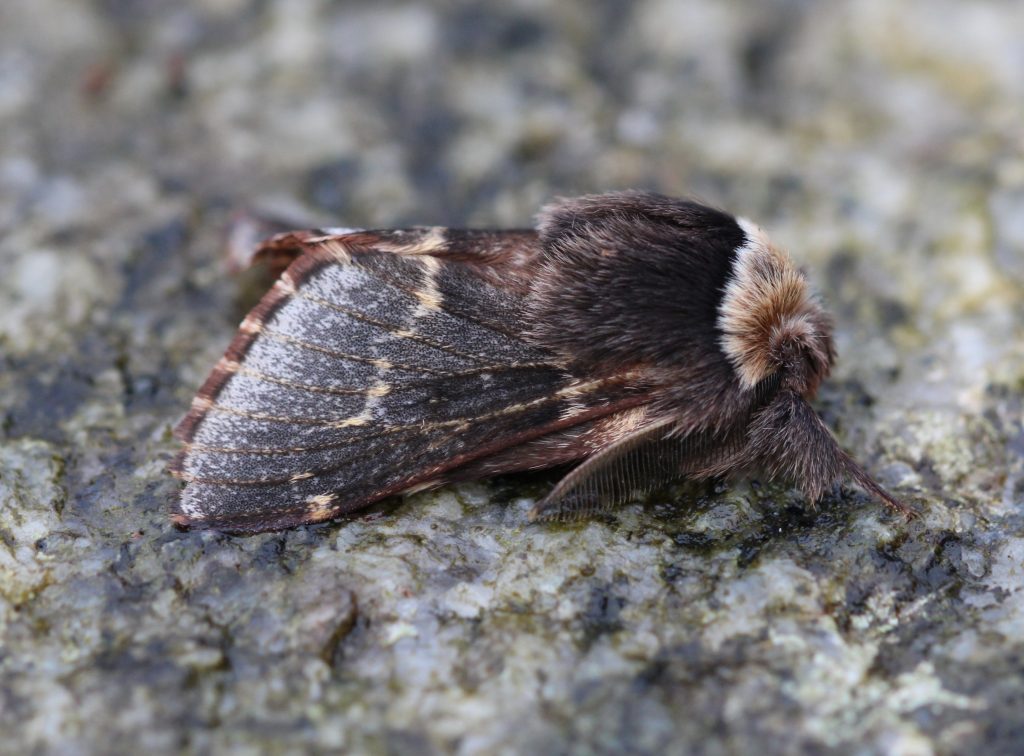 The December Moth is the most abundant winter flying moth in Ireland’s gardens.
Conserve Moths
Native hedgerows with extended field margins, scrub mixed with native grassland, native woodland and ponds with adjoining marshy ground will promote moth conservation in gardens, parks and in the countryside. Avoid chemicals in gardens, exercise a relaxed approach to gardening by mowing less, allowing grassland vegetation to flower and leaving vegetation patches near your native hedge uncut, and cutting only part of your native hedge helps to conserve moths and ensures amphibians, birds, bats and other insects have plenty to eat. What’s good for moths is good for nature.
References
Allen, D., O’Donnell, M., Nelson, B., Tyner, A., Bond, K.G.M., Bryant, T., Crory, A., Mellon, C., O’Boyle, J., O’Donnell, E., Rolston, T., Sheppard, R., Strickland, P., Fitzpatrick, U., & Regan, E. (2016) Ireland Red List No. 9: Macro-moths (Lepidoptera). National Parks and Wildlife Service, Department of Arts, Heritage and the Gaeltacht, Dublin, Ireland.
Nelson, B., O’Donnell, M., Bond, K.G.M., O’Connor, A., Marnell, F. Cotter, S. (2024) ‘CHECKLIST OF THE BUTTERFLIES AND MOTHS (LEPIDOPTERA) OF THE BURREN REGION OF WESTERN IRELAND’, Entomologists’ Record and Journal of Variation. Edited by C.W. Plant, Volume 136 ((Part 5 Supplement)).
Roberts, S. (2025) Garden Moth Scheme 2025: The State of Garden Moths in Great Britain and Ireland. Centre for Biostatistics, University of Manchester, Manchester.
SILVER-WASHED FRITILLARY by Jesmond Harding
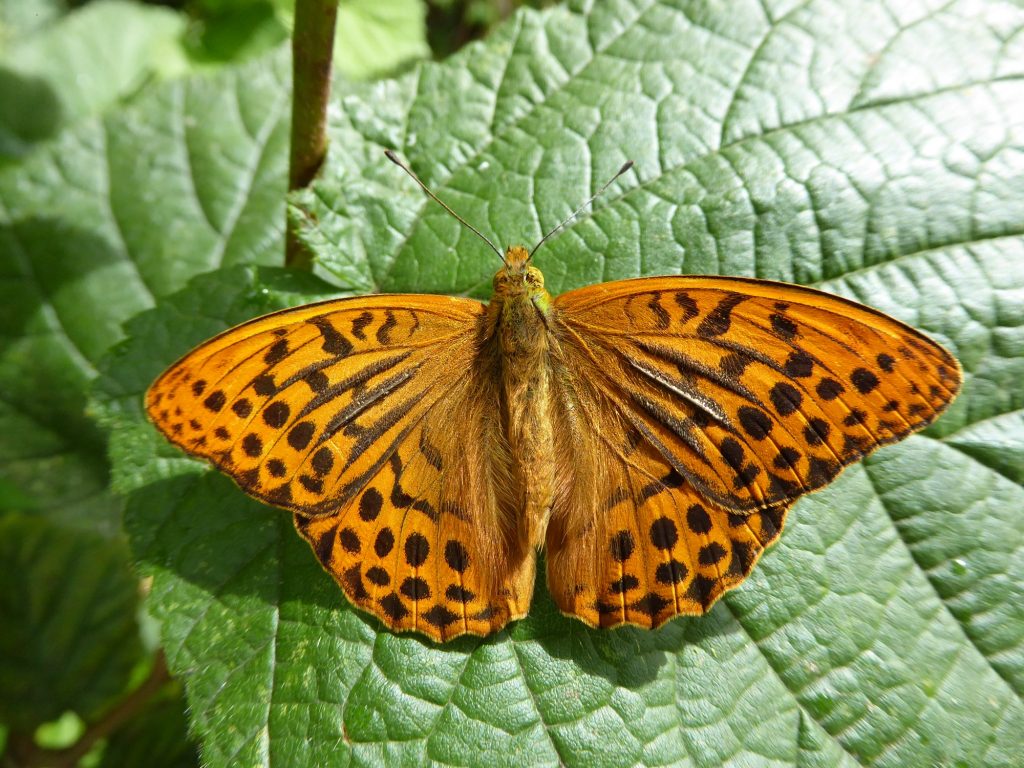 Silver-washed Fritillary male. Note the black bars on the forewings, containing scent scales used in courtship.
DESCRIPTION
The Silver-washed Fritillary is one of Ireland’s woodland species. It has the largest wingspan of our native butterflies, ranging from about 69mm to up to 80mm. This size variation occurs within and between colonies. The sexes appear similar on the wing. Males differ by having prominent black bars and spots, chevrons, and diamond markings on the deep, bright, orange forewing uppersides while females lack the bars and are paler orange. Both sexes have beautifully patterned undersides, with the largely greenish hindwing suffused with pale silver streaks and the forewing a muted orange with black markings. The fresh adult male’s orange ‘velvet’ glow is one of mid-summer’s special sights.
HABITAT
This butterfly occurs in native broadleaf woodland and woods containing broadleaf and coniferous trees. Broadleaf woodland containing mostly native trees with clearings and rides will hold populations, provided Common Dog-violet, the larval foodplant, occurs in sufficient populations and in the correct situations, with sufficient light and dry, dead plant litter warming the larval foodplant.
The National Survey of Native Woodlands undertaken between 2003 and 2008 (Perrin et al, 2008) concluded that there are four principal native woodland types in Ireland: oak woodlands, ash woodlands, alder woodlands and birch woodlands.
These are further divided into 22 subtypes.
Here are some native woods that can contain the Silver-washed Fritillary.
Native woodland types that hold populations of the Silver-washed Fritillary include subtypes of QL Sessile oak – woodrush Quercus petraea – Luzula sylvatica woodland type such as QL3 Bramble-Hazel Rubus fruticosus agg. – Corylus avellana sub-type: This type occurs on more fertile and base-rich soil than the above, i.e. on acid brown earths and early-stage brown Podzolic, and the flora contains several species characteristic of woodland on calcareous soils. In this respect, the stands may be considered as transitional to the Ash-Ivy woods. The oak canopy also contains Ash Fraxinus excelsior and sometimes beech. Sycamore (non-native), birch and Rowan Sorbus aucuparia are occasional. The presence of several broadleaf herbs distinguishes this vegetation type from the other sessile oak stands. They include Bluebell Hyacinthoides non-scripta, which may be dominant, violets Viola riviniana/Viola reichenbachiana, Enchanter’s Nightshade Circaea lutetiana, Herb-Robert Geranium robertianum, Barren Strawberry Potentilla sterilis and Wood Avens Geum urbanum. Woodrush is frequent but typically not plentiful. Tomnafinnoge Wood, County Wicklow show many of the features of QL Sessile oak – woodrush Quercus petraea – Luzula sylvatica woodland type.
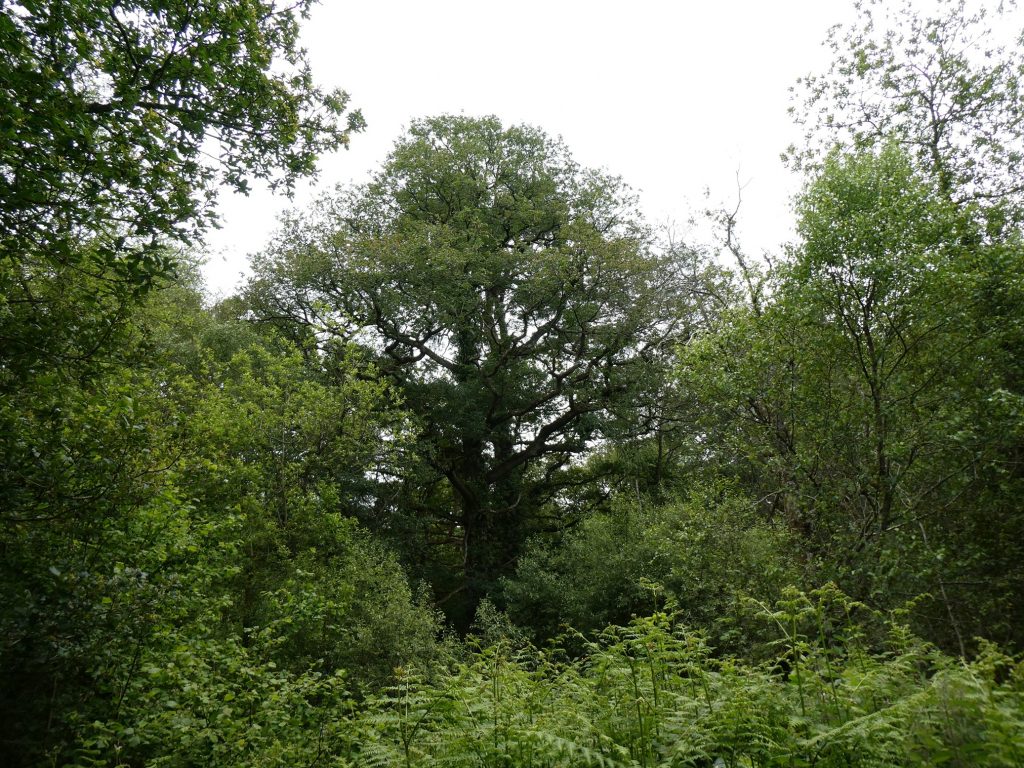 Tomnafinnoge Wood, County Wicklow.
FH Ash – Ivy Fraxinus excelsior – Hedera helix woodland type. Ash, Hazel and Pedunculate Oak woodlands of relatively dry, mostly base-rich, mineral soils in the lowlands. Woodlands dominated by Ash and Hazel are the commonest type in Ireland on dry to moist, fertile soils of the lowlands. They are generally much richer in flowering plants than the sessile oak woods and often have a colourful spring flora with plants such as Bluebell, Wood Anemone Anemone nemorosa, Primrose Primula vulgaris, violets, Lesser Celandine Ranunculus ficaria and orchids, such as Early Purple Orchid Orchis mascula. The woods near Tullamore, County Offaly, show these characteristics.
AF1 Ash – Remote Sedge Fraxinus excelsior – Carex remota sub-type: these stands occur on base-rich, fertile and often mineratrophic (environments that receive nutrients primarily through groundwater that flows through mineral-rich soils or rock, or surface water flowing over land) gley soils, which may be waterlogged but tend not to be inundated. Included here are stands on flushed hillsides, stream and river margins, narrow lakeshore woodlands, waterlogged hollows and poorly draining mineral soils elsewhere. Like all vegetation types in this group, these stands are species-rich. The canopy is dominated by Ash and Alder with occasional Pedunculate Oak and Grey Willow, although this latter species is typically more abundant in the understorey, along with Hawthorn and some Holly and Hazel. The principal species of the field layer are Bramble and Meadowsweet, each of which can be abundant. Ivy and Honeysuckle are frequent. The field layer is often diverse and may include Remote Sedge, Lady Fern, Creeping Buttercup, Herb-Robert, Enchanter’s Nightshade, Wood Avens, violet and Marsh Bedstraw. The woods in Knocksink, Enniskerry, County Wicklow, contain elements of this woodland sub-type.
BM6 Purple Moor-grass – Tormentil Molinia caerulea – Potentilla erecta sub-type: These are stands of birch woodland typically occurring on basin peats where the water table is high. Included within this category are rare native woodland communities associated with soak systems on raised bogs, stands in peaty hollows in the uplands and woodlands occurring on partially degraded bogs. The light, sometimes very open canopy is dominated by birch, with grey willow also frequent and locally Scots pine. Woods in Lodge Bog, Lullymore, County Kildare, contain elements of this woodland.
FH3 Hazel – Wood Sorrel Corylus avellana – Oxalis acetosella sub-type: These are species-rich Hazel/Ash stands of well-drained, fertile mineral soils. They include i) stands of species-rich high forest where Ash forms a canopy above a sub-canopy of hazel, and ii) Hazel scrub/woodland on limestone pavement, shallow, rocky soils and sometimes esker ridges, where the hazel canopy is typically, low (5-8 m) and in which Ash occurs as scattered emergents. Pedunculate Oak, birch, Rowan and Sycamore are occasional and some of our less common shrubs and trees, such as Irish Whitebeam Sorbus hibernica, Yew Taxus baccata and Purging Buckthorn Rhamnus cathartica may be present. Bramble, Ivy and Broad Buckler-fern are abundant in the field layer that is typically rich in broadleaf herbs, including Wood Avens, Wood Sorrel, Bluebell, violets, Barren Strawberry, Herb Robert, Wood Sanicle and Enchanter’s Nightshade. The woods in the Burren National Park correspond strongly to this woodland sub-type.
The Silver-washed Fritillary also occurs in native woods that do not correspond precisely to those described above, and in some non-native woodlands. An example of these woods is coniferous plantation forestry that is open, with well-spaced trees allowing light to reach a field layer containing Bramble and a mixed grass and sedge community with Common Bent Agrostis capillaris, Sweet Vernal-grass Anthoxanthum odoratum and Sand Sedge Carex arenaria, such as Ravenwood, County Wexford.
Occasionally, Silver-washed Fritillary will be found outside their sylvan birthplaces. Mature gardens and parks will occasionally receive visits from individual butterflies. Another feature of the adult Silver-washed Fritillary is that it is more often seen in open areas than within adjoining shady woodland. The adult butterfly needs open, flower-rich areas within its woods. In these areas, it warms itself, feeds and seeks mates.
To look for breeding areas, you must leave the adult feeding and mating areas in the sunny clearings and woodland rides and observe where the males, in search of newly emerging females, swoop low over ground vegetation in more shaded areas within woodland or follow a single female fluttering low in this habitat. Check for the presence of violets, usually Common Dog-violet, and make a careful search of the plants and the surrounding vegetation for the larvae during bright sunshine in the following May.
Typically, breeding areas will have several patches of violet, including many mature plants among low straggly scattered Bramble, grass tufts containing green and bleached blades, sedges, mosses, lesser amounts of Ivy and abundant leaf litter and plant debris, especially dead twigs and small branches. The soil is usually moist and sometimes waterlogged. The ground conditions in most Silver-washed Fritillary breeding sites I know are damp, including the Hazel woods in the Burren. Some breeding areas are flooded during winter, but the over-wintering larvae on the tree trunk are immune to this problem. The choice of these damp areas may reflect the larva’s need for highly succulent foodplants. Many violet plants in their breeding sites show feeding damage in May and June, typically in the form of a curved half-moon shape at the edges of the leaves. The breeding sites are partly shaded, with perhaps 40-50% of available sunlight reaching the ground.
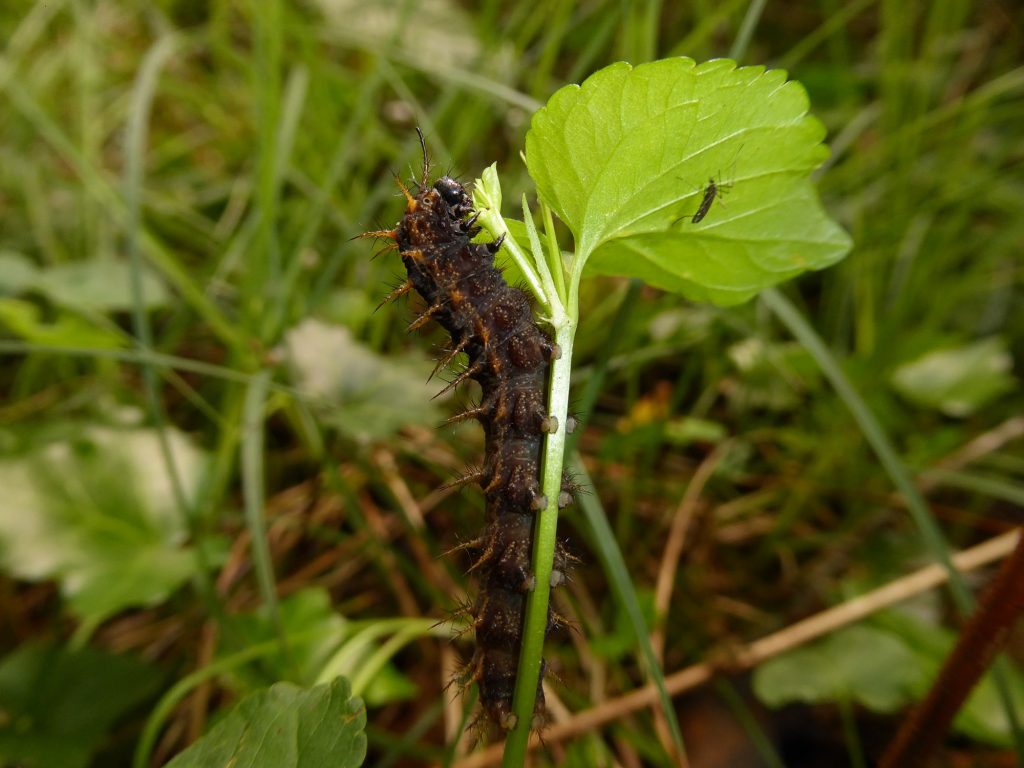 Silver-washed Fritillary caterpillar on violet.
FLIGHT TIMES AND BROOD STRUCTURE: While it can be seen in June, the flight period typically begins in the first week of July and ends by the second week of September. The peak of the flight period occurs in late July or early August, depending on the season, site and latitude. Generally, it emerges earlier in the warmer south-east than in northern areas. There is one brood.
BEHAVIOUR AND LIFE CYCLE: Males are more prominent and emerge first. They can be seen on Brambles and thistles, especially Creeping Thistle. Males swoop rapidly over clearings and sweep up to the treetops, apparently vanishing into the canopy, only to appear moments later perched on a pink blackberry blossom before circling energetically around the wood edges, jinking into every shaded recess, prospecting for a female. At other times, he dashes along the rides, clashing with rival males, other butterfly species and dragonflies.
Males appear to be sexually immature when they first emerge – they spend time basking and taking nectar, showing little inclination to seek a mate. Flowering bushes in a sunny, sheltered clearing can hold a bachelor party of over a dozen males eagerly feeding up. The adults are extremely restless in hot weather, giving little chance of a close view. The best opportunity for a good photograph is when adults emerge when conditions are bright but cool, as this prompts prolonged dorsal basking.
The Silver-washed Fritillary has a fascinating life cycle. Their courtship is remarkably charming, almost romantic, and can be observed in July in most deciduous woodlands where light bathes violets on the woodland floor. When a male locates a willing female, a synchronised aerial courtship follows, with the female maintaining a straight flight line, while her suitor swoops below her and then loops in front of her. When she is impressed, she and the male land, and the male wafts scent from his forewing’s black scent bars over her antennae by bowing towards her, closing his wings over her antennae. Utterly seduced, pairing occurs. The male carries the female to a tree, and there they settle to mate, both resting with closed wings.
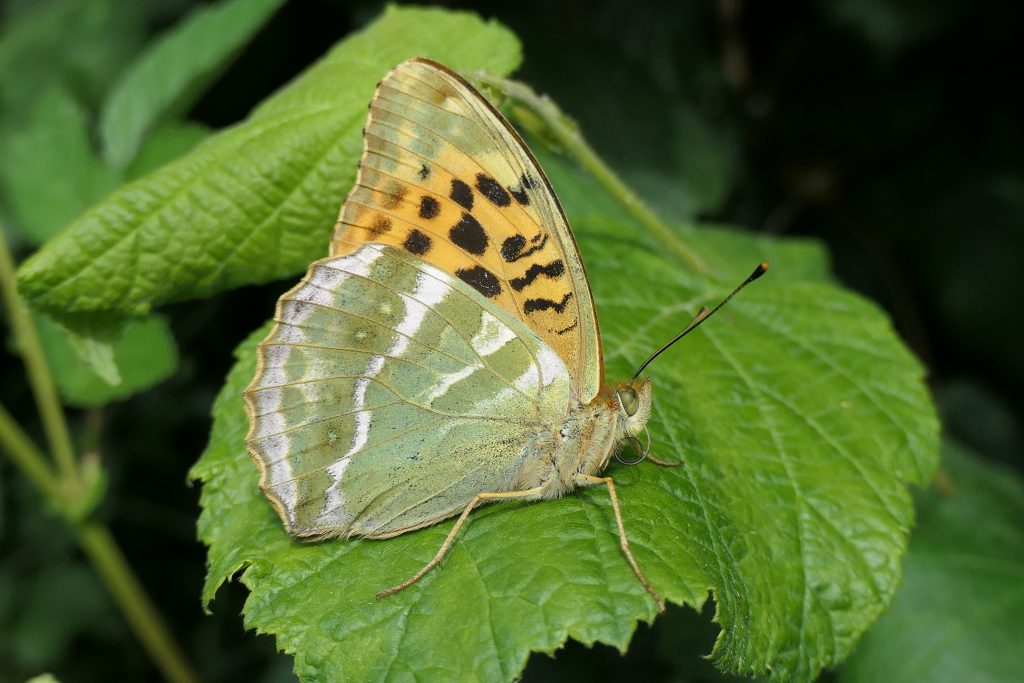 Silver-washed Fritillary underside. This is a female, but the undersides appear alike in both sexes.
The female Silver-washed Fritillary has a unique genital projection called the cornucopia. The cornucopia partly penetrates the male genitalia during copulation. A recent study suggests that penetration by the female cornucopia occurs passively, and it is hooked and pulled by the male towards the male genitalia using sharp teeth on the uncus (hooked area). This hooking and pulling causes wounds on the dorsal region of the cornucopia. Artificial amputation of a cornucopia confirmed that it is indispensable for spermatophore transfer from males and functions to break off the male phallic spines (spermatophore is a packet containing sperm and nutrients transferred to the female during mating). The broken spines may be used by females to help the digestion of spermatophores in the female’s corpus bursae (a bag-like structure that receives the male’s spermatophore, stores it, and helps digest its nutritious contents, influencing female receptivity and egg development. Its inner walls often have spiky structures that aid in breaking down the spermatophore). Females with larger body sizes had more broken spines in the corpus bursae, indicating that secure holding of a large female during copulation is challenging for males. Males vary considerably in size, and larger males might therefore have a mating advantage.
Females only become conspicuous when laying eggs and this is worth seeing. Females flutter low over the ground, locating the scent of violet species, the larval foodplants. She tends to seek areas that receive good sunlight, such as near the end of a path or along a ride, or near a clearing but within the wood itself. Violets near tree trunks or violets growing beneath coppiced Hazel are favoured. Typically, she then lands on a tree trunk nearby, settles and deposits at least one egg (c.1mm high), sometimes more, on the shaded sides to avoid desiccation of the egg and larva. Females will lay on mossy trunks of Common Hawthorn, but oak, pine and other trees are also used. The eggs may be laid less than 1m above ground, but are often placed considerably higher. Egg-laying was observed on a pine trunk at Ravenwood, County Wexford, c.4m up. Beech trees are rarely, if ever. chosen for oviposition because violets growing under them are in deep shade, and the larvae require sunlight to make digestion possible. Another problem is that Beech trunks are smooth, lacking the crevices to conceal the overwintering caterpillar. The freshly laid ovum is a rich cream colour, cone-shaped and has distinctive vertical ribs. It turns white just before hatching.
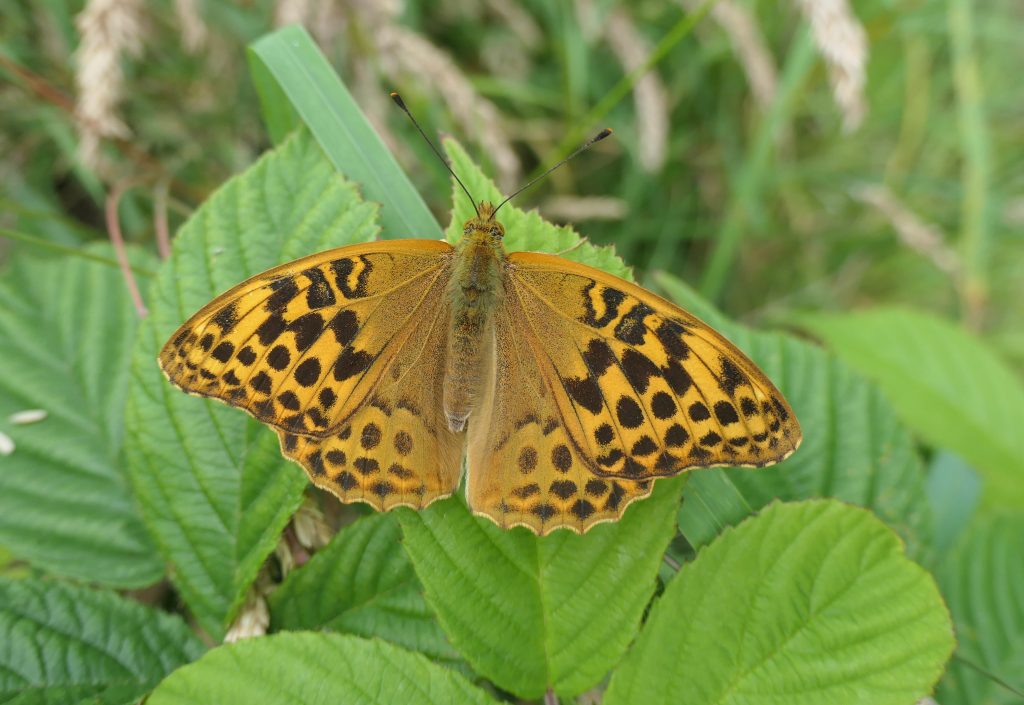 Female Silver-washed Fritillary basking during a cloudy interval.
The egg hatches after two weeks and after eating its eggshell, the caterpillar hibernates on the tree. It emerges in spring and begins its long journey down the tree trunk to seek violet leaves. By early May, the caterpillar is developing very quickly, moulting every six days. Moulting takes place on the underside of violet leaves. Like all nymphalid larvae, it is a spiny creature, with the foremost pair of spines pointing forward in the final two instars, giving a horned appearance. Early instars show bright dorsal lines running the length of the body and overall, the body has a network of pale whitish and dark brown markings running longitudinally. The fourth instar has a velvety black overall body colour with prominent pale-yellow dorsal stripes running the length of its body, separated by a thin black line. The ground colour in the final-stage (fifth instar) larva is a rich brown and the dorsal stripes are a richer yellow.
The caterpillar spends much of its time basking away from the foodplant and it is extremely difficult to see as it often lies on brown leaves in bright sunshine with tiny shadows cast by wispy grass, adding to the blending capability of the caterpillar. When feeding, it takes long, curved bites out of both mature and tender leaves. It also eats young shoots, flowers, pods and seeds and roosts under the leaves. After bouts of voracious feeding, it rests with the head slightly to one side.
The presence of a half-grown fourth instar larva among large final-stage caterpillars suggests that asynchronous development exists. Pupation of the larger larvae I observed occurred over two weeks. These differences in growth rates would account for the appearance of fresh individuals throughout July and early August. Large larvae reduce large mature violets to a few leaves. When fully grown, they can reach about 39mm. When ready to seek a pupation site, the caterpillar abandons its foodplant and wanders with a sense of urgency. It attaches itself to the underside of a twig with silk and hangs by its anal claspers. The pupation site may be only 100mm above the ground. It pupates after two days of lying in this position. The larvae observed pupated from the end of May through to mid-June.
The pupa is around 22mm long, pale brown, resembling a wizened fallen leaf. It has three parallel pairs of gleaming metallic silver-gold dew-like conical projections on the dorsal surface of the abdomen and two pairs on the thorax. The metallic gold mirrors the colour of the surroundings. If placed in a green box, the gold becomes a metallic green. This is doubtless intended as camouflage to help it blend in with the changing colour of vegetation. If disturbed, it wriggles violently. The pupa becomes dark grey prior to emergence. The pupal stage lasts about fourteen days and up to three weeks in cool conditions.
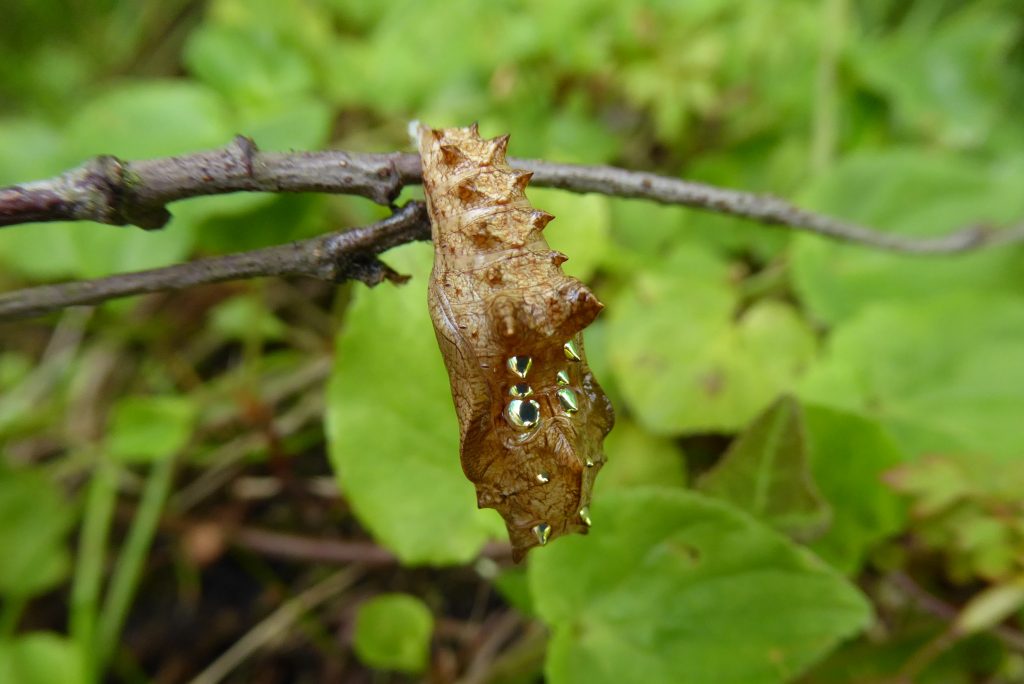 Silver-washed Fritillary pupa.
IRISH DISTRIBUTION
The Silver-washed Fritillary is found in suitable woodland and taller scrub throughout Ireland and is expanding its distribution, because new habitat is becoming available and probably because the climate is warming. Over the past three decades, new native woodland has developed on abandoned cutaway/cutover bogs throughout Ireland, especially in the west and midlands. Much of this consists mainly of Downy Birch with willow, especially Grey Willow. Twenty years or so after peat-cutting ceases, many of these have developed to the liking of the butterfly, with abundant foodplant and light on the woodland floor. Hazel woods are maturing in the Burren, providing new habitat in Clare and Galway, while elsewhere the butterfly is colonising the deciduous wood belts planted at the edges of commercial forestry. Current native tree planting initiatives, such as the Hare’s Corner and the 2014-2020 GLAS scheme (Green, Low-Carbon, Agri-Environment), might provide new habitats for the butterfly in the future.
Currently, the information obtained by the Irish Butterfly Monitoring Scheme is insufficient to determine population (abundance) trends. However, An Atlas of Ireland’s Butterflies 2010-2021 shows it has increased its distribution. It has increased from 248 10km squares before 2010 to 422 10km squares in 2010-2021. Increased recording is responsible for much of the recorded increase, but it has certainly moved into new woodland that has been developing on abandoned land and where new woods have been deliberately created.
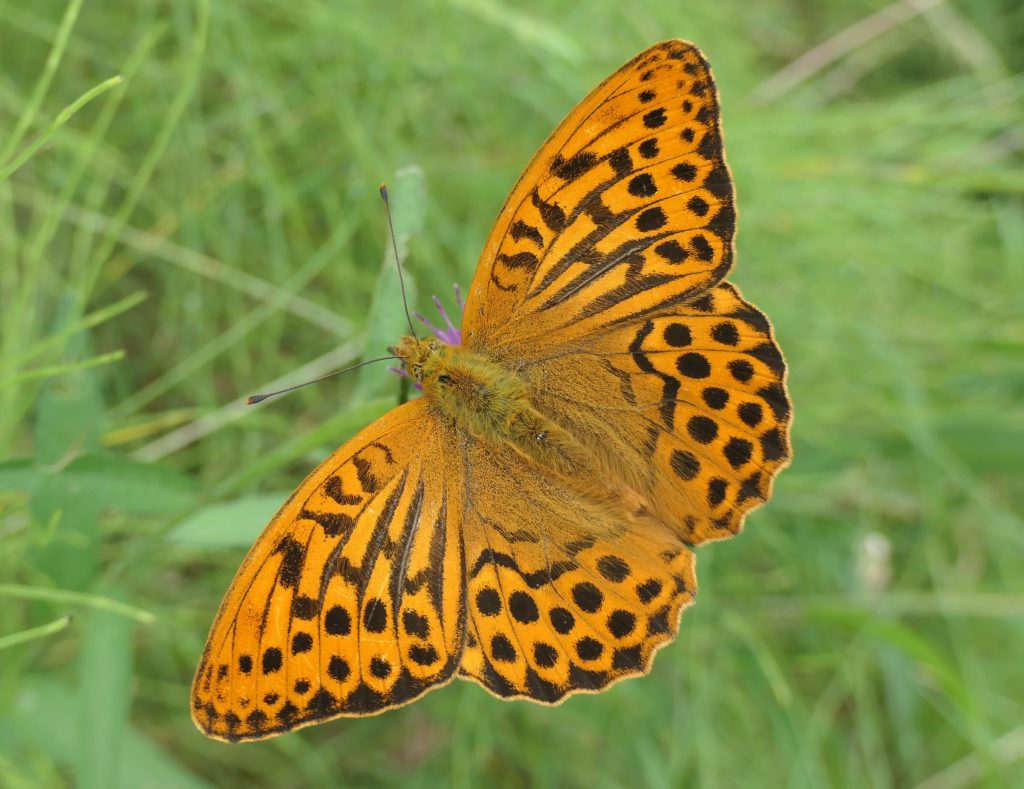 A pristine male Silver-washed Fritillary, Lullybeg, County Kildare.
Strangely, the species is more widely distributed in Ireland than in Britain. It is absent from Scotland, despite occurring nearby in Northern Ireland, such as Ballycastle Forest, Antrim, 31km from Scotland. It is rare or absent from North Wales and most of Northern England, and areas in the midlands. Its strongholds are in South Wales and across the south of England, especially in the south-west. It is expanding its distribution in England, and was recently seen near Newcastle’s border with Northumberland, after an absence of over 170 years (https://www.bbc.com/news/articles/cly9zd9zr9do). It appears that some are being released into woods far beyond its known range, by nature lovers who long to see it return. It was remarkably abundant in the New Forest, Hampshire, in the 19th century. That is certainly not true of the area today, where I have seen only occasional individuals.
We should rejoice in the increase of our most iconic woodland butterfly. Increasing shade in developing plantation forestry will shade it out of some woods, but the increase in woodland and mature scrub elsewhere may offset or more than compensate for any such loss. It is also a resilient butterfly, capable of hanging on for many years in small, suitable areas of woodland until more becomes available. This can happen when woodland spreads naturally or where felling occurs, leaving some non-timber trees like birch, when trees are thinned, or woodland sites are restored by the removal of non-native trees, which has occurred in some woods owned by Coillte, the state forestry body. Creating clearings, turning points and widening rides in plantation forestry can also create new habitat. Another example of how a new habitat can appear was observed in plantation forestry in Lullybeg, County Kildare, when many tall Lodgepole Pines died during the extreme cold in 2010, leaving hardier trees like Scots Pine and Downy Birch in place to produce an open, brighter wood.
References
BBC (2025) Rare butterfly spotted for first time since 1850. Available at: https://www.bbc.com/news/articles/cly9zd9zr9do (Accessed 31 December 2025)
Harding, J. (2021) The Irish Butterfly Book A Complete Guide to the Butterflies of Ireland. Privately published, Maynooth.
Harding, J. & Mapplebeck, P. (2025) Silver-washed Fritillary Argynnis paphia Pp 90-91. In Harding & Lysaght (2025) An Atlas of Butterflies in Ireland 2010-2021. The National Biodiversity Data Centre. Waterford.
Matoba, T., Kamimura, Y. & Yoshizawa, K. Is the copulation of silver-washed fritillary inverted? Function of the female genital projection (Lepidoptera: Nymphalidae: Argynnini). Org Divers Evol 23, 871–879 (2023). https://doi.org/10.1007/s13127-023-00621-y
Perrin, P., Martin, J., Barron, S., O’Neill, F., McNutt, K. & Delaney, A. (2008) National Survey of Native Woodlands 2003-2008. National Parks and Wildlife Service, Dublin.
Photographs by Jesmond Harding unless otherwise stated. Copyright belongs to photographers.
BUTTERFLY CONSERVATION IRELAND ANNUAL REPORT 2025
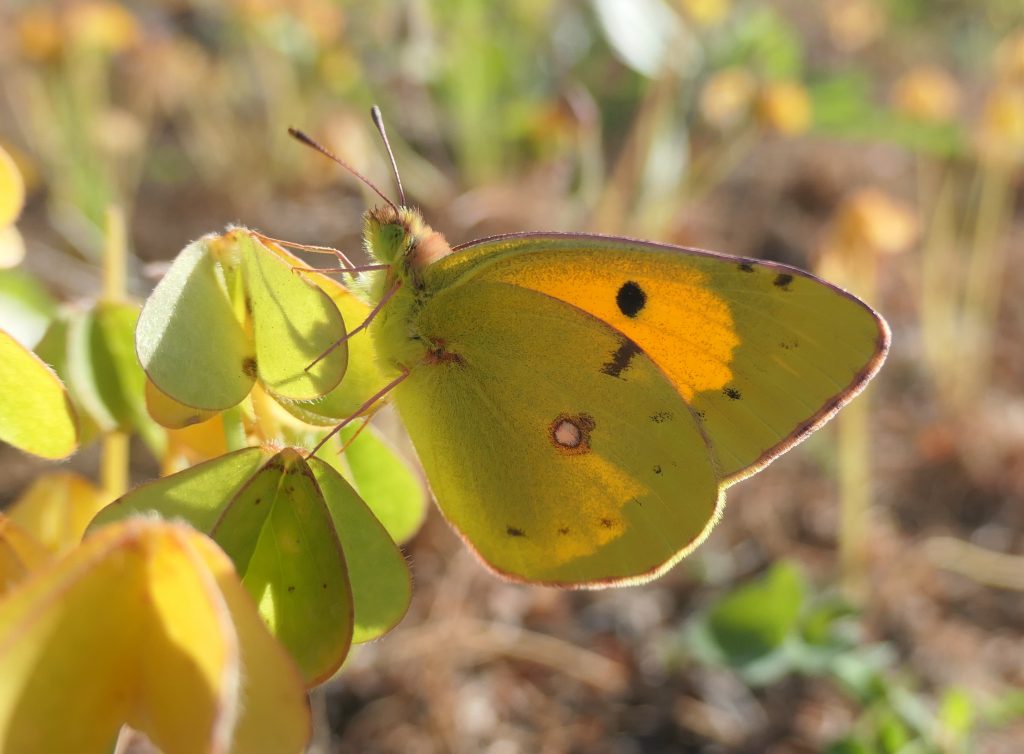
BUTTERFLY CONSERVATION IRELAND is a company limited by guarantee. Registered in Ireland No. 451571.
BUTTERFLY CONSERVATION IRELAND is a charity. Registered Charity no.: 20069131.
CONTACT DETAILS:
By email: conservation.butterfly@gmail.com
By post:
Butterfly Conservation Ireland
Butterfly House
Pagestown
Maynooth
County Kildare
By phone:
01-6106693
Website: https://butterflyconservation.ie/wp/
Facebook: https://www.facebook.com/