Here comes the rain again
Raining in my head like a tragedy
Tearing me apart like a new emotion
(Annie Lennox, Dave Stewart)
One topic that we rarely tire of is the weather. In the colloquial sense, Ireland does not have a climate; it has weather. Our weather influences every living thing in Ireland, and the irascible unpredictability of conditions permeates our national obsession with the rain, sunshine, wind, and temperature that exerts such influence over our experience of life.
Met Éireann, the state’s meteorological service, describes Ireland’s climate by referring to just two seasons: ‘Winters tend to be cool and windy, while summers (when the depression track is further north and depressions less deep), are mostly mild and less windy.’ (1) So, cool and windy and mild and less windy. As Father Ted says when giving directions, ‘The field with fewer rocks than most fields you see.’
Another constant, aside from unpredictability, is rainfall. Cold, bitter, splashy, severe, gentle, soft, relentless, intermittent, you name it, we get it, sometimes more than one form simultaneously. We are an island, surrounded by wet stuff, so, unsurprisingly, it is soaked into our national consciousness.
The rain and its best friend, the grey sky, are the reasons we love to holiday abroad. I doubt many of us like trusting our lives to Ryanair, but to get off this island to sunny climes, we need to escape by air to get our annual doses of Vitamin D.
Even this is becoming a problem. Anyone who has holidayed in southern Europe in June, July or August over the last decade will know how unpleasant the heat has become. It is intolerable. One cannot venture outdoors after 10 or 11 am, and it is not until around 4 pm that it is safe, let alone comfortable, to put a foot outdoors. In July 2019, I arrived in Malta at two in the morning. It was 27 degrees Celsius. Many of us are now booking our sun holiday for April, and September and October for this reason. This ensures that you get the desired sunshine while temperatures are like those in a ‘nice’ Irish summer.
But will this change? Met Éireann thinks so. According to its climate change page, summers will be hotter and drier with temperatures possibly rising by more than 2°C, and rainfall decreasing by approximately 9%. Winter will be hotter and wetter, with temperatures possibly rising by more than 2°C, and rainfall possibly increasing by up to 24%. These are not baked in certainties but will depend on the degree of future climate warming.
At present, we are seeing increases in summer and winter precipitation of 2.71mm and 4.05mm per day, respectively. An increase in the global temperature average of 1.5 °C will see a 1.37% decline in summer precipitation and a rise of 11.24% in winter precipitation. By winter, Met Éireann means December, January and February. Summer is June, July and August. We are at 1. 3 °C above pre-industrial levels. Projections are made for +2 °C, +3 °C and +4 °C, if you can bear to look. (2) The magnitude of rainfall events is also expected to increase. (3)
These increases are probably partly due to natural causes, but not only to these. Science has pointed strongly at human behaviour as a leading cause of climate change.
Natural factors that influence climate are altitude, latitude, distance from the sea, ocean current, direction of prevailing winds and El Niño, which affects wind and rainfall patterns.
Another natural factor is vegetation, and human behaviour is altering the planet’s vegetation cover, especially by removing trees, adding to emissions of gases that heat the planet’s atmosphere. Human activities, especially modern farming and burning fossil fuels, add to anthropogenic global warming.
Some of the changes exceed the ability of living things to adapt. For example, decreased rainfall means that some plants that require an adequate store of water in underground tubers during their dormant periods could struggle to survive. The decline in soil moisture might have caused the likely extinction of the orchid Yellow Spider Orchid (Ophrys lacaitae) on Malta. Increased windiness causes tall flowering plants to sway, making them less accessible to pollinators. Species like the Bee Orchid Ophrys apifera, is taller, reaching up to 70 cm in height, and might be less visible to pollinators as well as harder for pollinators to reach in windier conditions. (4)
In southern Europe, the Meadow Brown (and other species) show adaptive behaviour, coping with extreme summer heat by retreating to woods and scrub during intense summer heat and emerging later to lay eggs. If Ireland ever experiences such heat in the future, where are the woods for it to retreat to?
Some conditions do not allow for survival. Intensive farming has a major impact on wildlife by simply removing habitat or modifying it beyond the ability of plants and animals to survive. The impact of artificial fertilisers on the survival of some moth and butterfly larvae is already known. The effect of nitrates on water, air, vegetation and climate change is also well established.
Unfortunately, we tend to react when changes we don’t like are already occurring. ‘Why weren’t we warned?’ cried those badly impacted by recent flooding in Dublin and the southeast. Warnings have been published for years. It is only when the warned event happens that we ‘know’ it’s true.
A call to build flood defences was made by Dr Clare Bergin, Maynooth University, to deal with climate change-induced flooding. (5) Most of our drainage measures are designed to remove water from land asap. In fact, these measures are everywhere. Drainage ditches are found almost everywhere in Ireland, along roads, the edges of fields, alongside rivers, and in deepened and dredged rivers and streams. Bogs and fens had drainage channels dug to drain water before peat cutting could proceed. In most state-owned bogland that has been cut for peat, those not gravity-drained are kept drained by using pumps. On most state-owned peatland these pumps are still in operation, delivering vast quantities of water to rivers. Before our lowland bogs were bogs, they were lakes. Following peat extraction, they will return to being lakes, holding water rather than swelling rivers, if pumps were switched off. Here is one solution to flooding. But I don’t hear anyone mentioning it.
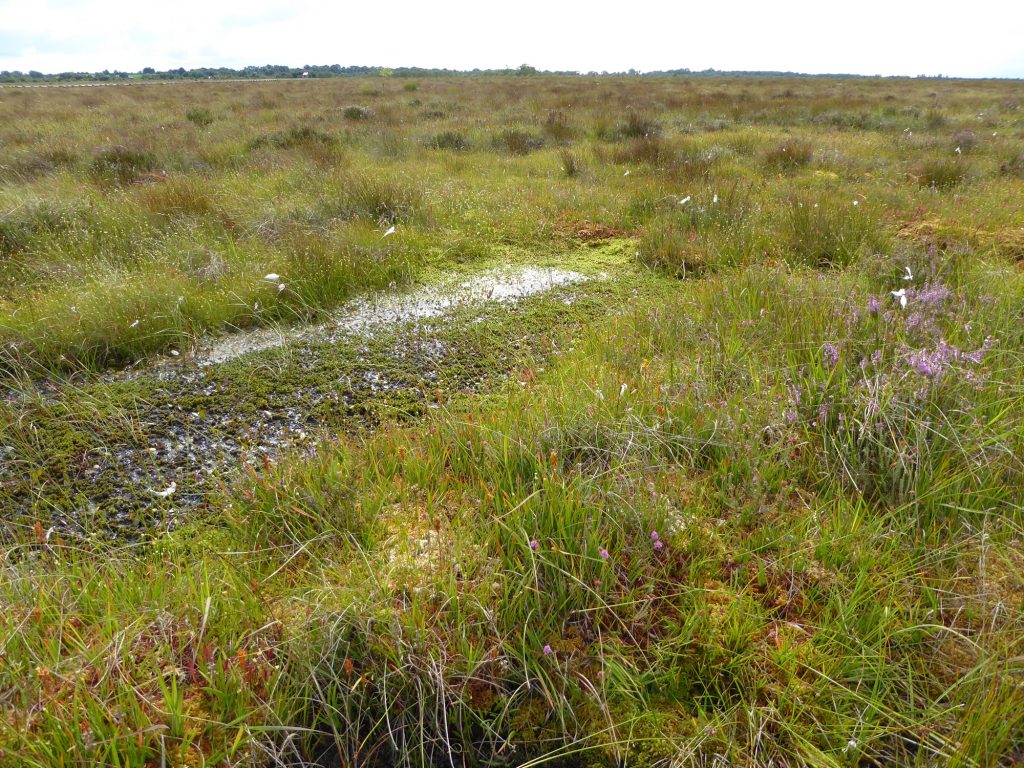
Farmland must also be allowed to flood. Time was when every farm had a pond. These were filled in, and water pushed off land as fast as possible. The movement of water must be slowed, not accelerated. This water moves to the coasts. Most of Ireland’s population lives in the low-lying east, in coastal areas, near estuaries. Nowhere is more likely to see flooding.
Restoration of wetlands (marshes, both freshwater and salt, fens, bogs, wet meadows, lakes, ponds, reed beds) must be applied to both abate flooding and absorb warming gases. Our wildlife will benefit hugely too.
Now get on with it. But don’t blame nature, don’t blame the Freshwater Pearl Mussel Margaritifera margaritifera. Blame what we did to nature and reverse the damage.
Footnotes
1. https://www.met.ie/climate/climate-of-ireland
2. https://www.met.ie/climate/climate-change
3. https://www.maynoothuniversity.ie/icarus/news/new-study-finds-climate-change-increases-flood-risk-southeast
4. Mifsud, S (2018). Orchids of the Maltese Islands. Green House, Malta.
5. https://www.rte.ie/radio/radio1/clips/22580181/
Well said Jesmond, we are the creators of our own fortune, good or bad. The solutions are staring us in the face but where is the will?
Thanks, Niamh. Warm air holds more moisture, so the warming climate means more rain for western Europe, especially during winter. Western Europe had 40 consecutive days of rain, we had about 60.