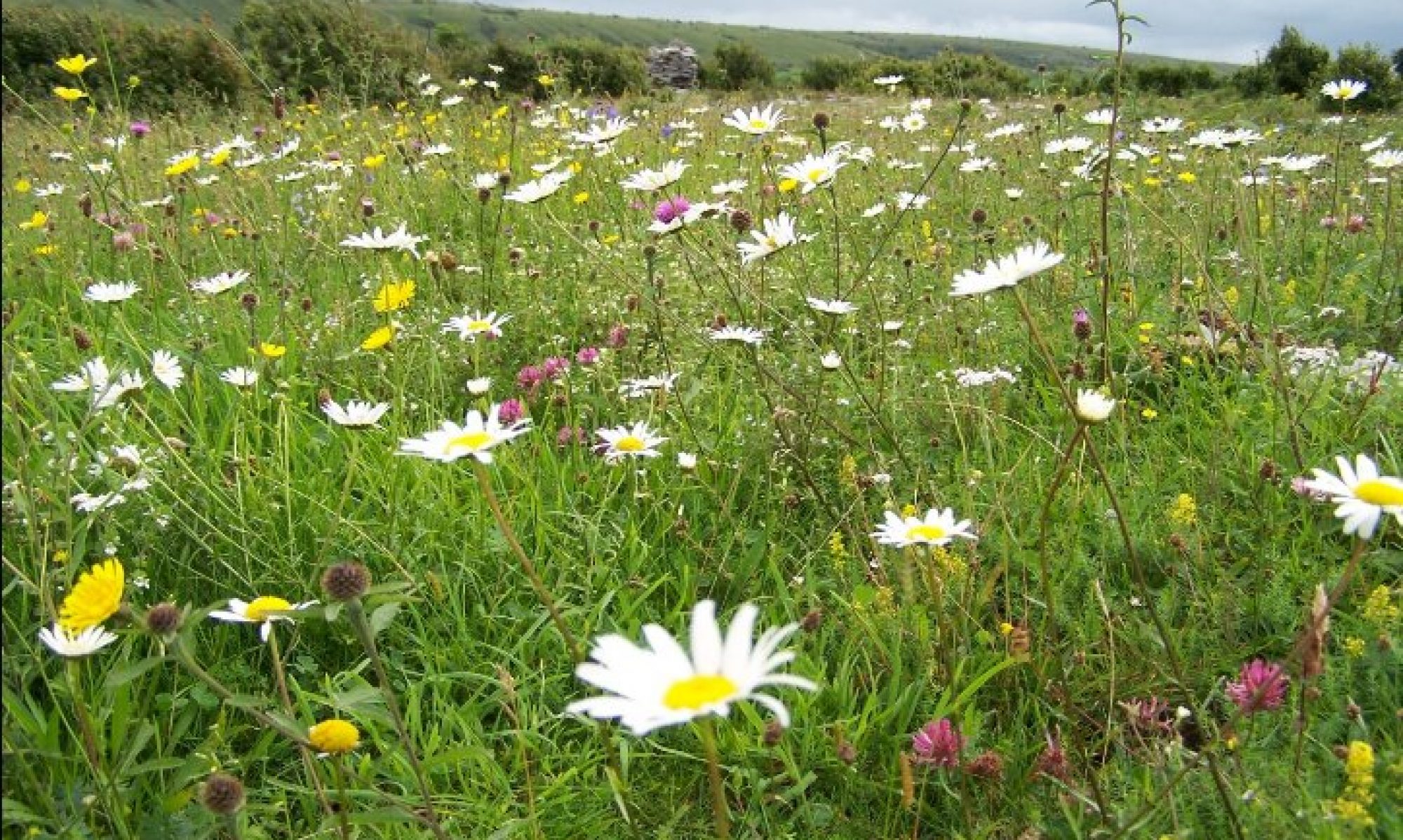
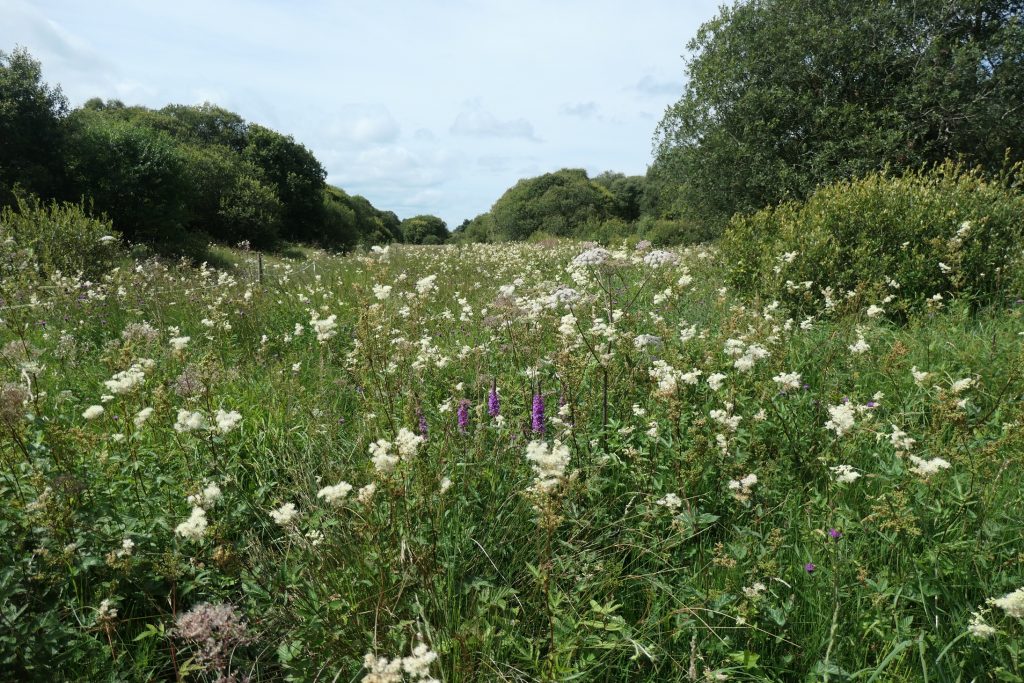
Butterfly Conservation Ireland’s reserve in Lullybeg, Kildare, is a special place for the Marsh Fritillary and many other butterflies, moths, dragonflies, and other species. The reserve is monitored using the transect count method, which involves counting all butterflies within a 5-metre square area along a fixed route walk in favourable weather each week between 1st April and 30th September, a total of 26 weeks.
The final count of 2026 was made on September 28th. Despite the late September date, 43 individual butterflies were counted:
Small Copper 2, Red Admiral 23, Painted Lady 1, Small Tortoiseshell 5, Comma 15, Speckled Wood 2.
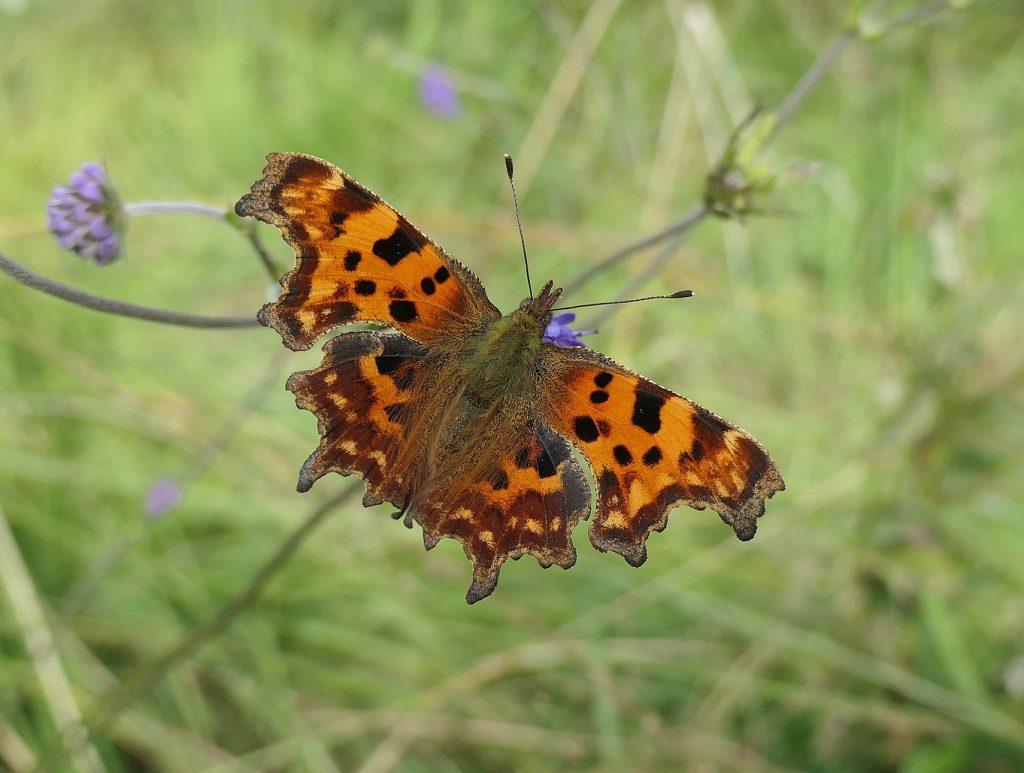
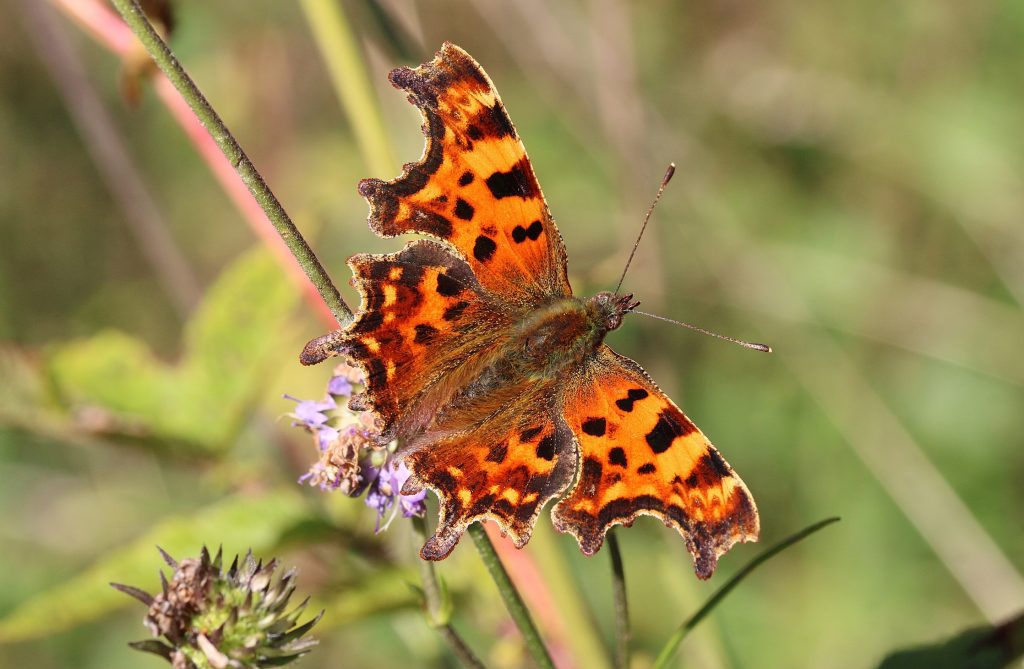
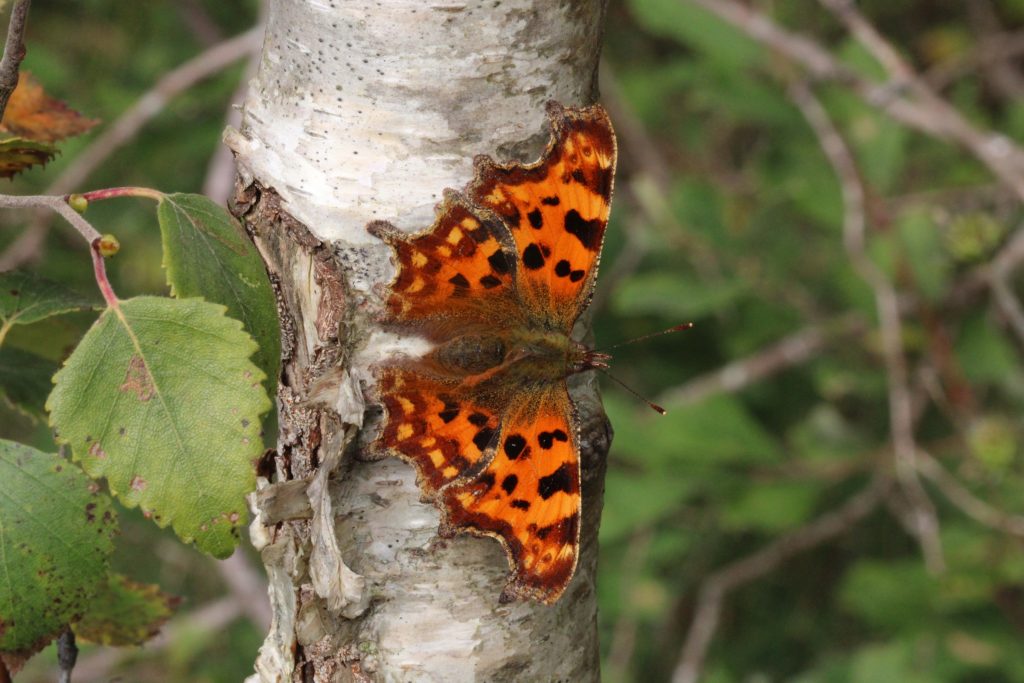
The Comma is numerous in the reserve this autumn. The Commas are feeding on nectar from Devil’s-bit Scabious to prepare to hibernate in wooded areas in the reserve and nearby.Comma in full light: in the wild, it looks luminous in bright sunshine. This photo was taken on 28 September.
This year, Jesmond Harding and Pat Wyse made the counts using the forms containing the standardised methodology issued by the National Biodiversity Data Centre. The results, sent to the National Biodiversity Data Centre, also appear in Butterfly Conservation Ireland’s Annual Report. These can be found here: https://butterflyconservation.ie/wp/report/
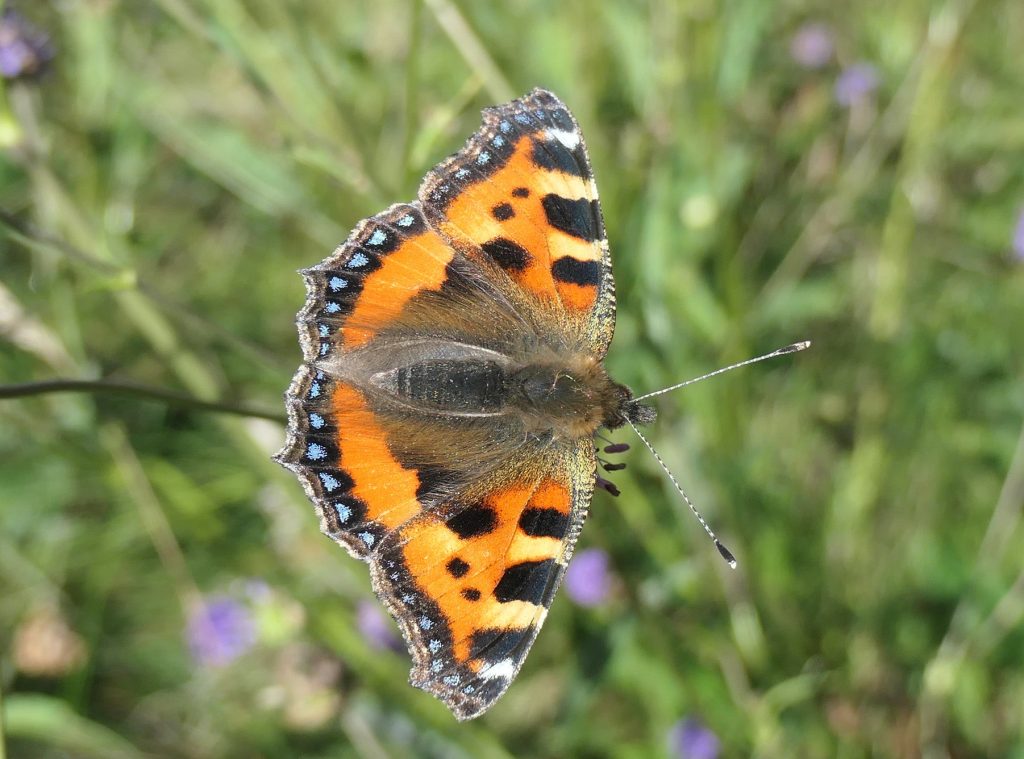
Small Tortoiseshell, Lullybeg Reserve, on 28 September. This butterfly will join the Comma in hibernating in wooded areas.
The reserve supports an excellent diversity of woodland and grassland butterflies, and the area is managed to maintain the supporting habitats.
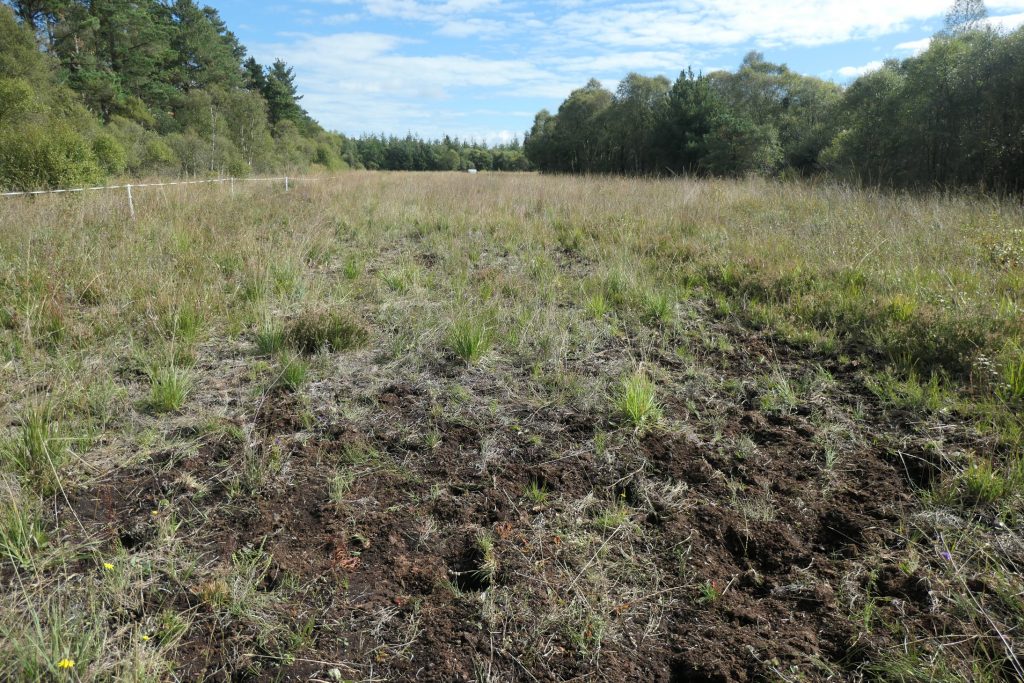
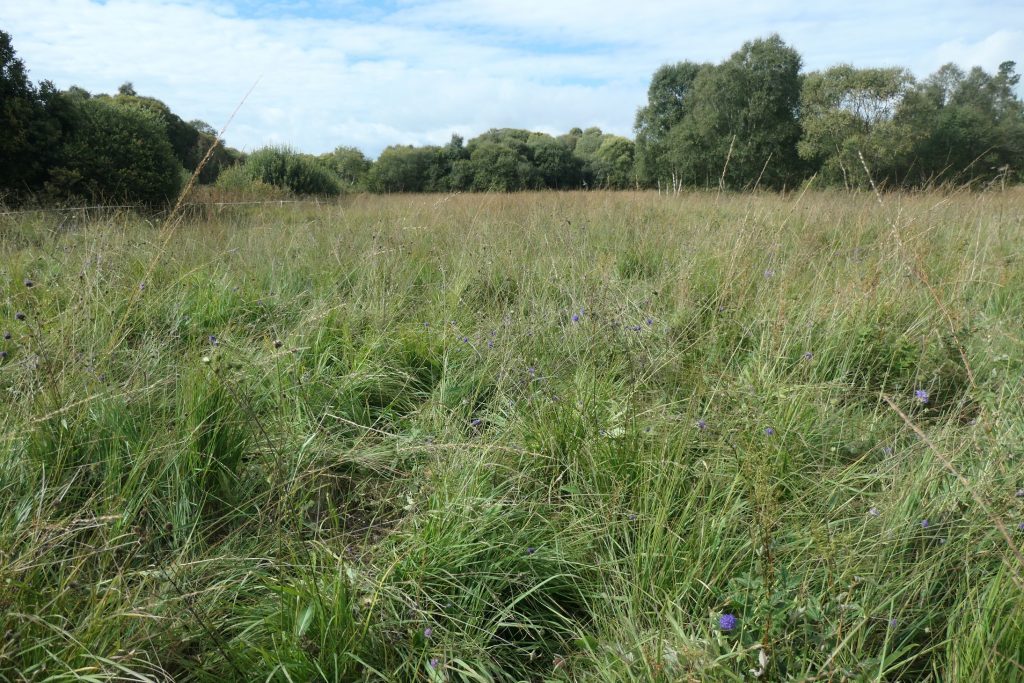
The conservation applied this September was cattle grazing. Cattle effectively maintain the undulating structure in grassland. Cattle graze less selectively than sheep and graze higher up in the vegetation. This creates a patchwork of sward heights, which creates greater floral diversity. Cattle also reduce sward heights, which increases light penetration and raises temperatures close to the surface of the soil. The temperatures just above the surface are crucial for many caterpillars. Poaching by cattle exposes the soil, which is excellent for butterflies like the Dingy Skipper, which enjoys basking on unvegetated surfaces. Poaching also exposes seed to light, supporting germination.
Poaching by cattle is important for butterflies because it creates basking surfaces for adult butterflies and heats adjoining vegetation, aiding larval development.
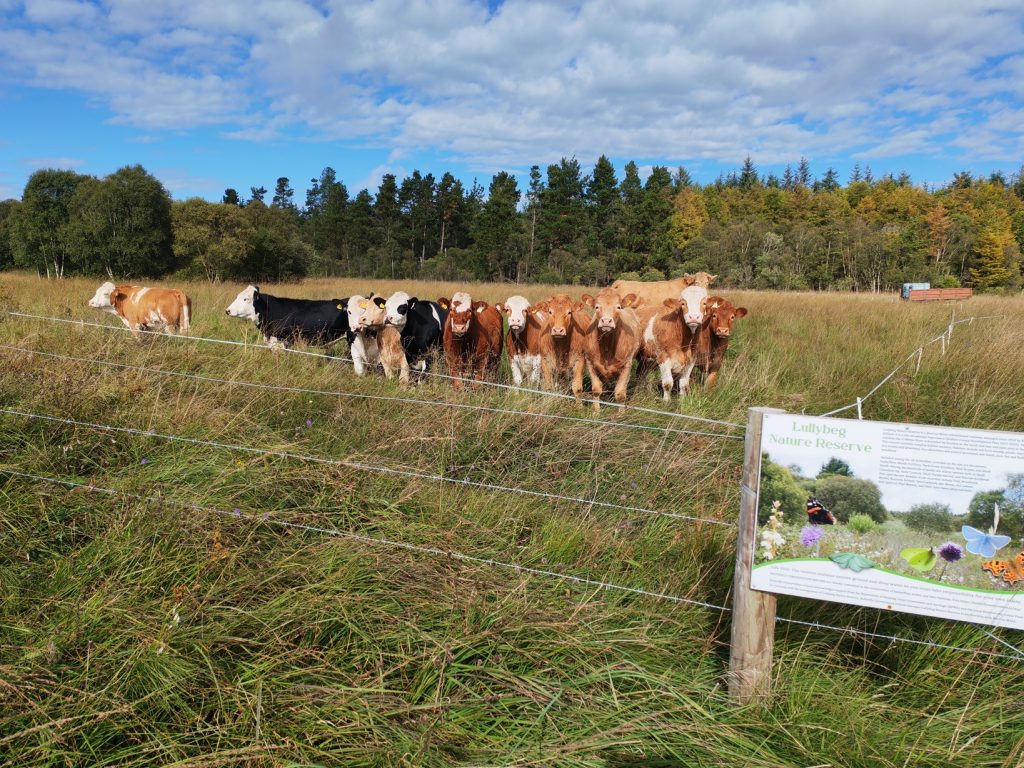
Butterfly Conservation Ireland would not be able to provide these benefits without help from local farmer Philip Doyle. Philip shows his care for local nature by delivering the cattle, ensuring that the fencing is suitable and that the animals have the water they need. We are grateful to Philip for this vital assistance.
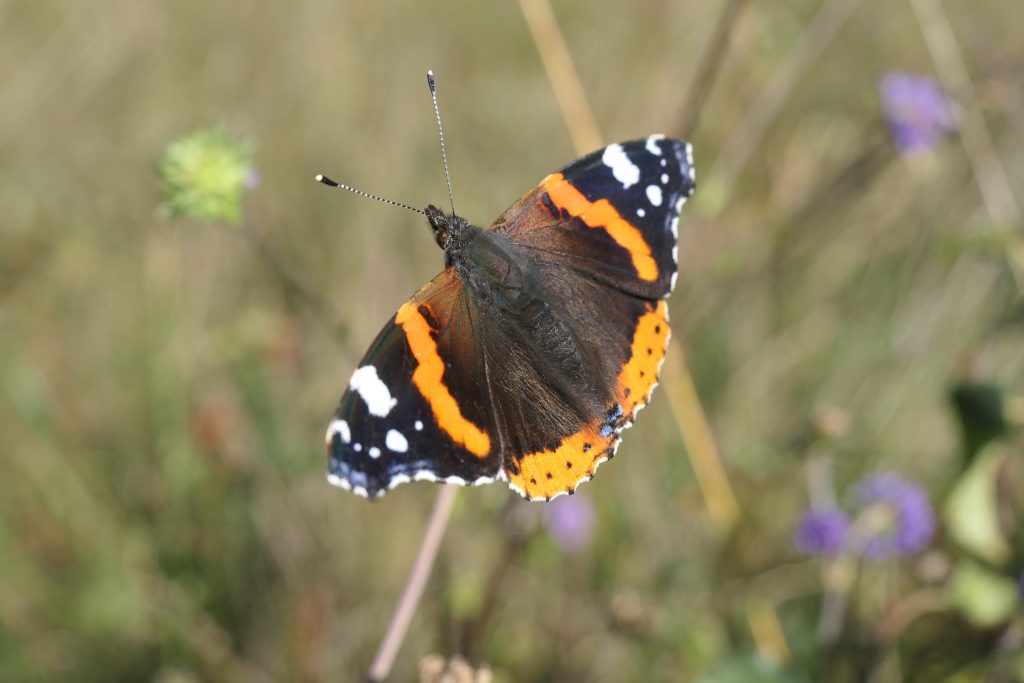
Cattle create a range of sward heights. The dominant grass here is Purple Moor-grass, which the cattle tackled, despite its toughness.This Red Admiral was photographed in Lullybeg Reserve on 28 September. At this time of the year, most Red Admirals are taking nectar to prepare for movement to Europe, where they will breed.Cattle, the butterfly’s friend, grazing in Lullybeg.
Lullybeg Reserve is one of only two reserves in Ireland managed for butterflies. The other, Lullymore West Bog Reserve, which is nearby, is managed by the Irish Peatland Conservation Council. These reserves benefit from support from members of both organisations. Please continue to support the conservation and research taking place in both reserves.
The golden September we often get is not ours in 2026, but many sunny Septembers offer a modicum of compensation for miserable summers. Summer 2026 was glorious, surpassing 1976 and 1989. Will it pass into the collective memory as a standout summer? That might depend on how we interpret climate data. We are in a time when hot, sunny weather is characterised as evidence of the collapse of the stability that has long characterised the global climate. Can’t we enjoy a hot summer without worrying? Apparently not.
That is not to be flippant about climate change, whether human-induced or arising from other influences. However, a remarkable feature of lepidopteran ecology is the rapid response to changing seasonal, climatic and environmental conditions. Changing climatic conditions can mean that ecological conditions within an area that were previously unsuitable for breeding become available for breeding. This is happening in Europe, Britain and Ireland.
The northward shift in butterfly and moth ranges is particularly evident in Europe, where range expansion does not require crossing water bodies. Species like the Map butterfly and the Peacock butterfly are extending their European range northward. The Brown Argus, formerly confined to breeding on Common rock-rose in the warmest habitats on chalk and limestone grassland in Southern England and Wales, has now expanded its British range, using cranesbills in cooler grasslands because the warming climate allows it to use these larval foodplants. Some species do not benefit from the warming climate, and some species benefit from the increasing warmth in some parts of their range and suffer declines in other regions.
Range expansions in continental Europe influence Britain and Ireland to a lesser degree; many species expanding on the continent will avoid crossing seas. However, migrant species are more mobile, and some show indications of establishing populations in these islands.
The most notable expansion from an Irish viewpoint is the Comma. Unknown in the Republic of Ireland before 2000, it has now been recorded in more than half of Ireland’s 10km squares, and its northward and westward expansion continues.
The lush Stinging Nettles along damp hedgerows, wood rides and edges, riverbanks and elsewhere suit it perfectly. It is thriving, producing two generations and is now a staple part of the butterfly experience in the east and midlands. Hedges holding blackberries and flowering ivy are the places to look in the general farmed countryside; wet grasslands and dry limestone grasslands with Devil’s-bit Scabious are also likely per-hibernation feeding grounds.
Comma at Lullybeg, County Kildare. This butterfly was feeding on Devil’s-bit Scabious.
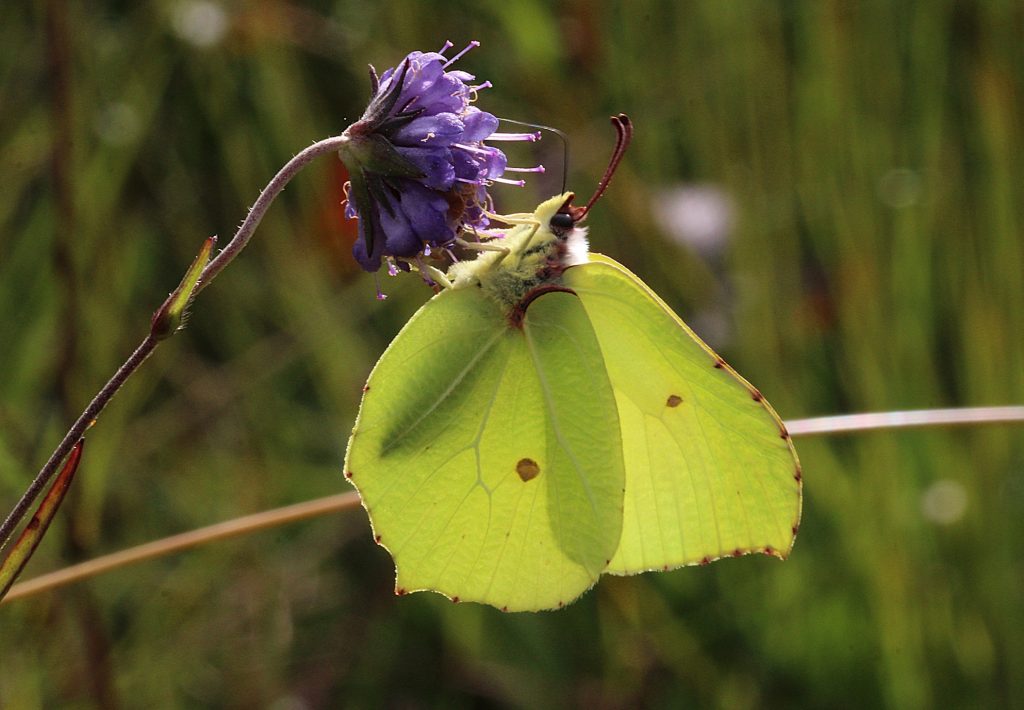
A stay-at-home butterfly to look for in September is the Brimstone. Most are in hibernation, but a few still feed on late flowers, especially Devil’s-bit Scabious, before disappearing into woods, scrub and dense grassland vegetation until next spring.
This lovely male Brimstone is on Devil’s-bit Scabious in Lullybeg, County Kildare. In September they will gather, often in numbers, to feed on flowers very near trees and scrub, where they will pass the rest of autumn and winter.
A glorious autumn moth that flies in a single generation in September-October is Merveille du Jour Griposia aprilina. Its scientific name is a strange choice. Linnaeus named it after April, when it is a larva, munching on oak leaves. Perhaps Linnaeus was thinking of the moth’s verdant colouring when composing the name. The moth is best imagined on oak boughs encrusted with lichens, where the moth becomes virtually invisible.
What is the main tool used by the state to protect the Marsh Fritillary butterfly?
The Marsh Fritillary is the only insect in Ireland that has legal protection. How is this implemented, and how successful is this effort?
Under the EU Habitats Directive 1992, certain geological features, habitats and species must be protected within Special Areas of Conservation (SACs). One of the species is the Marsh Fritillary butterfly. Ireland had to identify areas important for the Marsh Fritillary butterfly and designate them as Special Areas of Conservation. This was also required of European Union countries with populations of the butterfly. Where an area is designated for the butterfly, the butterfly is named as a ‘qualifying interest’ for the Special Area of Conservation. The full list of Ireland’s SACs can be found here:
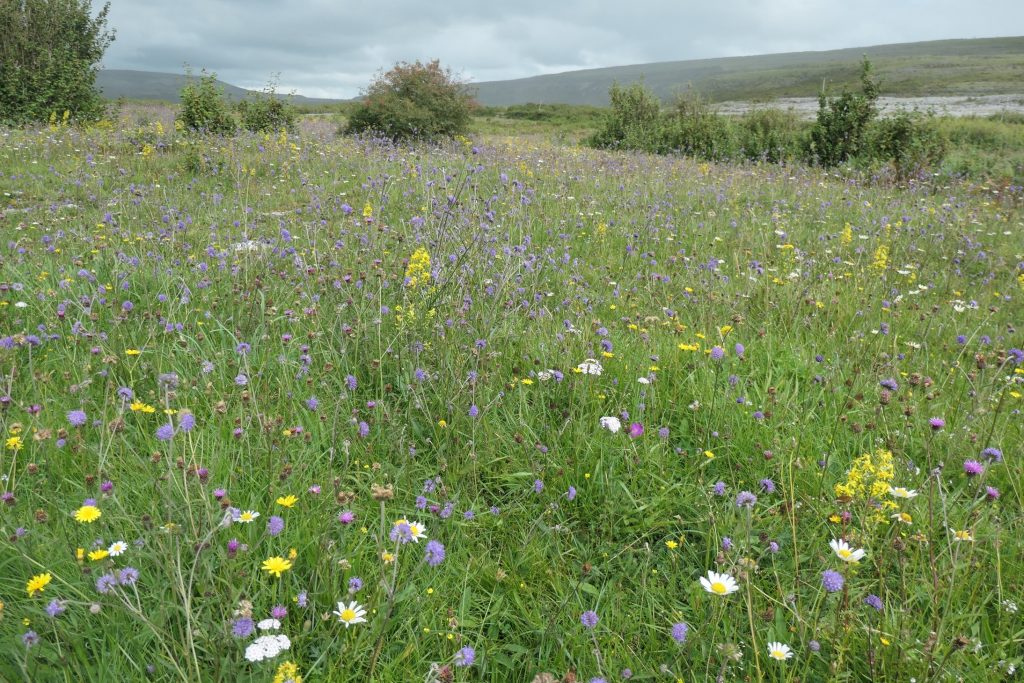
Semi-natural dry grasslands and scrubland facies on calcareous substrates (Festuco-Brometalia) (* important orchid sites) [6210] is a qualifying interest. This habitat is in the central Burren.How many Special Areas of Conservation have been designated for the Marsh Fritillary?
Ireland listed 12 SACs with the Marsh Fritillary as a qualifying interest (other qualifying interests are listed too). The 12 sites are listed here:
A check of the documents available for each site at https://www.npws.ie/protected-sites is interesting reading. The documents consist of
1. Conservation Objectives: these aim to define favourable conservation conditions for particular habitats or species at that site. The Conservation Objectives state whether the Marsh Fritillary is present and the area of suitable habitat within the SAC.
2. Site Synopsis: this states the site location, and summarises the habitats, species, and importance of the site and comments on any threats to the site’s conservation values.
3. Statutory Instrument (SI) and SAC maps: The SI designates the SAC, states the qualifying interest species and habitats, and sets out the activities that require ministerial consent. The maps identify the area occupied by the SAC.
What do the Conservation Objective Reports tell us about the butterfly’s status on the sites?
The Marsh Fritillary was recorded in just four of the 12 SACs where the butterfly is named as a ‘qualifying interest’. These are:
1. Bricklieve Mountains and Keishcorran SAC
2. East Burren Complex SAC
3. Moneen Mountain SAC
4. West of Ardara/Maas Road SAC
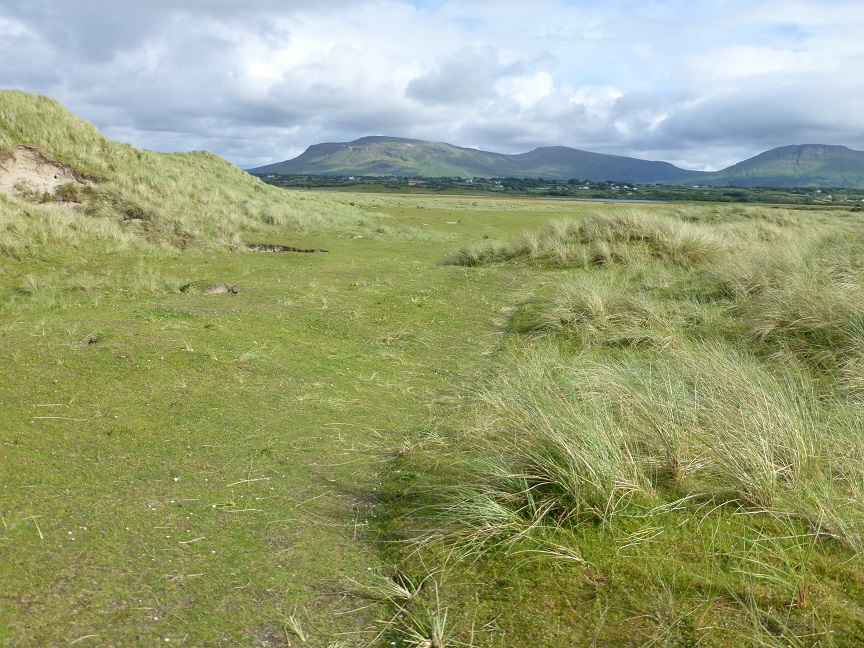
Bunduff, Sligo. The area contains fixed coastal dunes with herbaceous vegetation (grey dunes) [2130], humid dune slacks [2190], machairs (* in Ireland) [21A0], semi-natural dry grasslands and scrubland facies on calcareous substrates (Festuco-Brometalia) (* important orchid sites) [6210], and alkaline fens [7230], all habitats for the Marsh Fritillary.My records indicate it is extinct in Ballynafagh (last recorded 1999) and Killarney (last recorded 2006); the Barrigone report states that there are no confirmed records for that site. Remarkably, the Barrigone report states:
The association of the species with the SAC derives from a paper by Lavery (1993) which refers to a site called Foynes/Barrigone as one of three major populations in Ireland. A 2012 survey did not find the species in the SAC (Wilson et al., 2013).
Was Lavery correct when he wrote the paper? Did NPWS undertake a survey to confirm the species before the site was designated? Why is the Marsh Fritillary listed as a qualifying interest if it is absent?
The area occupied by the Marsh Fritillary at Barrigone has dried out and is now overgrown with scrub. Geoffrey Hunt, a reliable recorder, has searched the area regularly since 1998 and has not seen any Marsh Fritillary on the site. Geoffrey’s knowledge of the site raises questions concerning this statement from the site’s Conservation Objectives report:
In 2012, just over 9ha of habitat was assessed as suitable for the species (NPWS, 2019).
Is there any suitable habitat at Barrigone?
The Conservation Objective reports for the following four sites where the Marsh Fritillary is a qualifying interest for the SAC do not even mention the butterfly:
1. Bunduff Lough and Machair/Trawalua/Mullaghmore
2. Gweedore Bay and Islands SAC
3. Sheephaven SAC
4. St. John’s Point SAC.
I visited Bunduff Lough and Machair/Trawalua/Mullaghmore SAC (terrestrial area 1,812.12ha) and St. John’s Point SAC (terrestrial area 152.08ha) and found larval webs within these sites. However, while I did not measure the area of suitable habitat on these sites, the areas are not extensive.
I calculated the combined area of the SACs (excluding maritime areas for coastal sites) and, where provided, the area of suitable habitat for the butterfly. In two Burren SACs, NPWS estimated suitable habitat. Combined, the 12 SACs contain 159,647.26 hectares. The total suitable habitat stated is 5,725.2 hectares.
The ratio of suitable habitat in hectares to overall terrestrial area in these SACs is 1:28. There is one hectare of suitable habitat for the Marsh Fritillary for every 28 hectares of land.
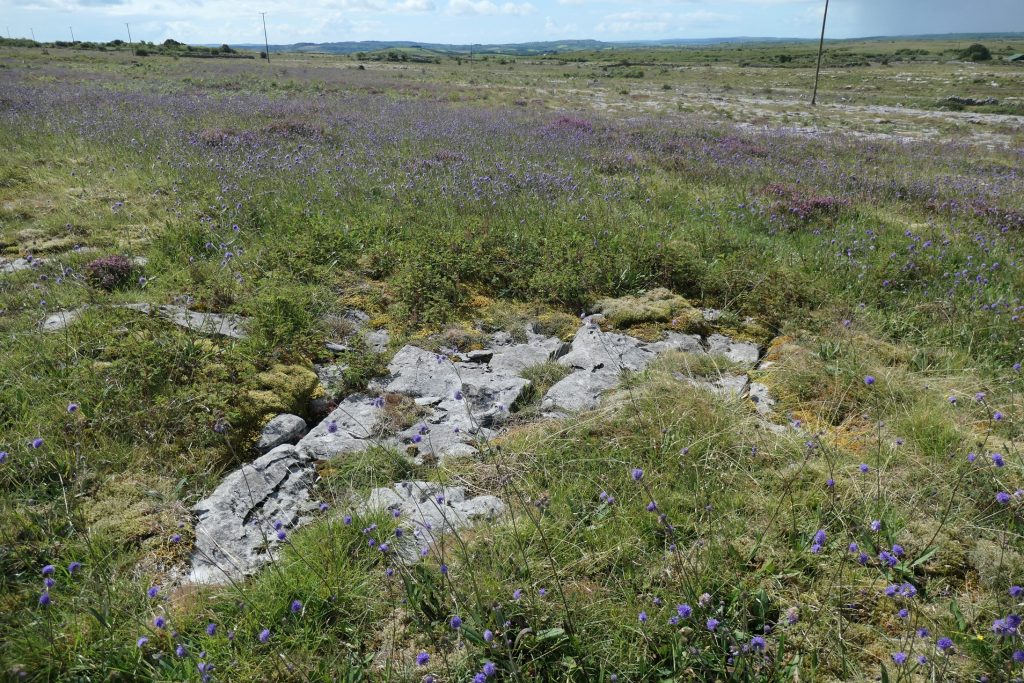
The Clooncoose district north of Kilnaboy contains a large area of suitable habitat for the Marsh Fritillary. In this area, the species occurs at a landscape level.
The Marsh Fritillary occupies the landscape in a metapopulation structure. It needs a network of sites within a region for long-term survival. In England, the minimum figure is 50ha (50ha2 is ½ km2) of suitable habitat within an area of 16km2 (1600ha) Bulman et al., 2007. (This ratio is 1ha: 32ha.). Modelling suggests the species may persist in areas below this area for decades, but extinction will eventually result unless additional habitat is provided. Irish research is needed concerning this aspect (NPWS, 2019).
If the ecology of the Marsh Fritillary reflects that in England, the combined habitat area across the 12 SACs designated to protect the species slightly exceeds the minimum threshold needed for long-term survival.
However, taken on a regional basis, only the two Burren SACs, which are extensive (but much smaller than the Connemara and Killarney SACs), contain habitat that significantly exceeds the minimum required. The Burren SACs and the habitat and habitat ratios are:
East Burren Complex (18800.65 ha (188 km2)): 3,200 ha (32 km2): ratio 1:6 and Moneen Mountain (6100ha (61 km2): 2,500ha (25 km2): ratio 1:2.4.
A thorough calculation of the ratio in regions holding the smaller SACs would need to factor in any suitable habitat adjoining the SAC to assess the species on a regional basis. It must be stressed that the exercise undertaken here is unrefined. The SACs in question are, in most cases, separated by significant distances and cannot be said to reflect the metapopulation structure of the species, so extrapolating the ratio of suitable habitat to the area in the SACs as a whole inadequately represents the ratio situation described by Bulman et al., which could be much lower in some areas.
The absence of detailed management plans for some SACs is another problem. How do we know if the habitat is being managed correctly? In this regard, it must be emphasised that the Burren’s populations are safe, for now.
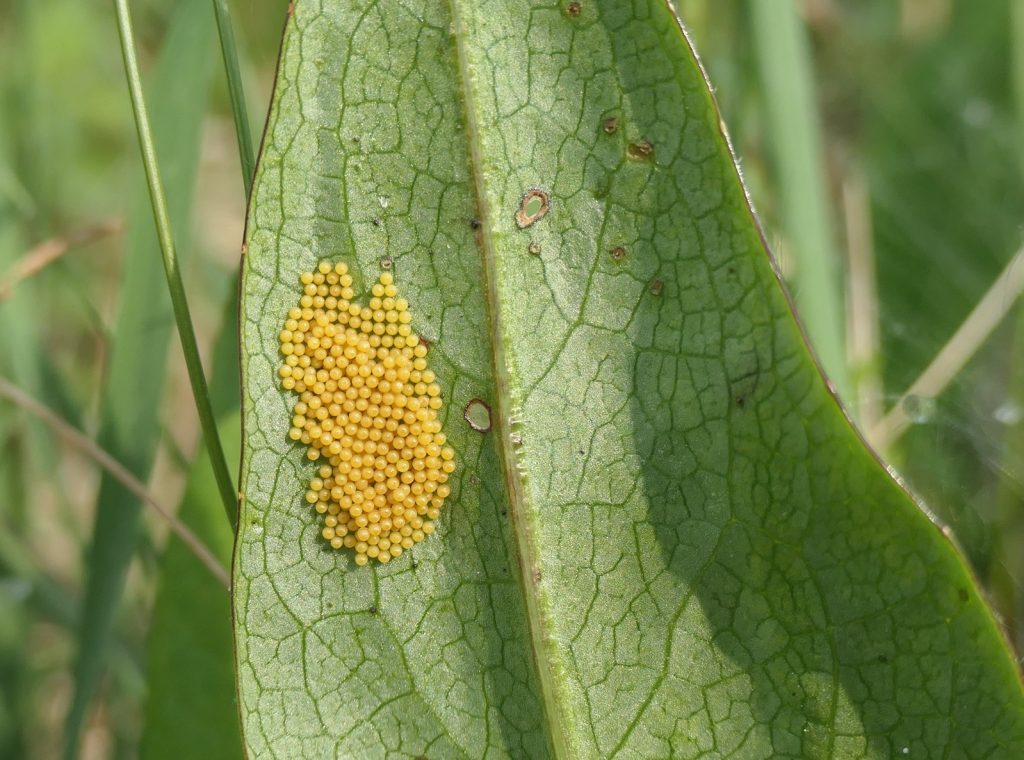
Marsh Fritillary egg mass, Lullybeg Reserve, County Kildare.
This cannot be said of many populations elsewhere. Look at Barrigone, once regarded as one of the three major populations in Ireland. Look at Killarney and Ballynafagh, where it is either very rare or no longer occurs. These are sites where protecting the Marsh Fritillary is a conservation priority.
Protecting the butterfly means protecting its habitat, which preserves many important habitats and species. The absence of the butterfly highlights poor habitat quality, bad practice and lack of care. In the view of this author, the summative assessment is ‘poor result is due to the lack of serious effort.’
The formative assessment is to apply the required habitat management techniques to restore and maintain habitat within SACs and expand the network of protected areas and manage these areas to meet the minimum habitat size of 50ha within 16km2 to ensure this lovely butterfly’s long-term survival.
The Marsh Fritillary often needs intervention to preserve its population, especially grazing.
Reserves Protecting the Marsh Fritillary
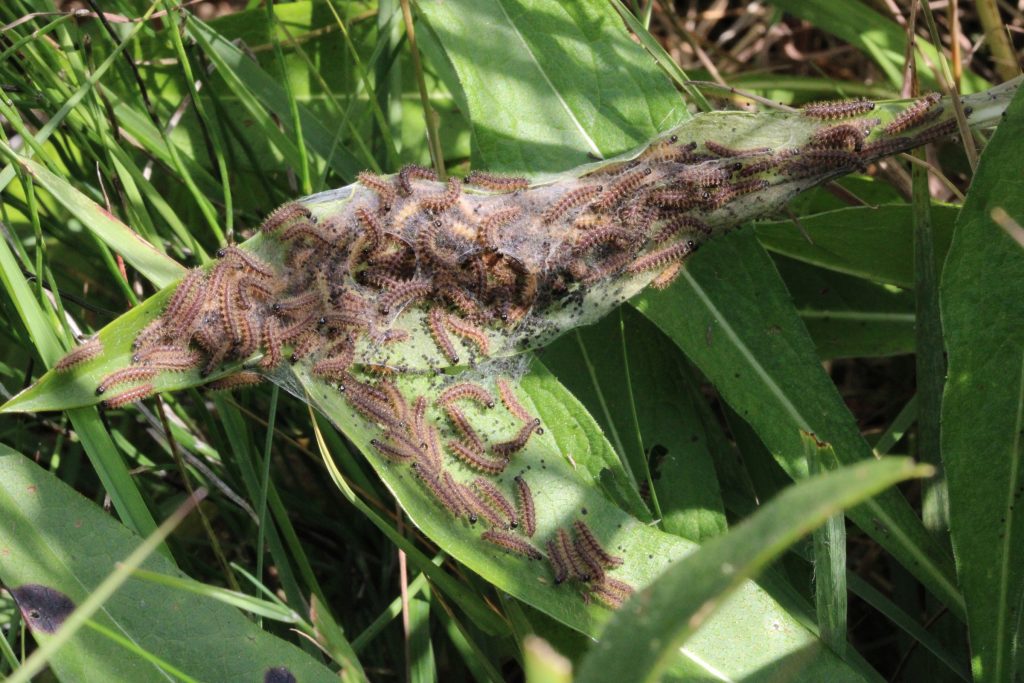
Two areas set aside for nature, where the land is specifically managed for the Marsh Fritillary, are Butterfly Conservation Ireland’s Crabtree Reserve in Lullybeg, and the Irish Peatland Conservation Council’s Lullymore West Butterfly Reserve, both in County Kildare. Both sites hold long-term, thriving populations. Both sites are managed for the butterfly. In August 2026, surveys found over 80 larval webs at these sites.
Marsh Fritillary larval web in August 2026, Lullybeg Reserve, County Kildare.
How is the Marsh Fritillary doing in Ireland?
An Atlas of Butterflies in Ireland 2010-2021, published in 2025, provides interesting information about the distribution of the Marsh Fritillary in Ireland.
The Atlas shows the species distribution in three periods: 1900-2010, 1995-2010 and 2010-2021. The number of occupied 10km squares in each of the periods is:
1900-2010: 435 (42.7%)
1995-2010: 248 (24.3%)
2010-2021: 355 (34.7%)
The distribution differs significantly across the three time spans, but the figures for the two most recent periods, when recording was more systematic, are more relevant.
A key issue arising with the 2010-2021 recording period is that in 100 of the 353 10km squares, only a single Marsh Fritillary was recorded. The Marsh Fritillary is a colonial species. A single butterfly is not evidence of a colony. If these 100 squares are discounted, this leaves its distribution at 24.8% of Ireland’s 10km squares. This would mean its distribution has remained almost unchanged since the 1995-2010 recording period.
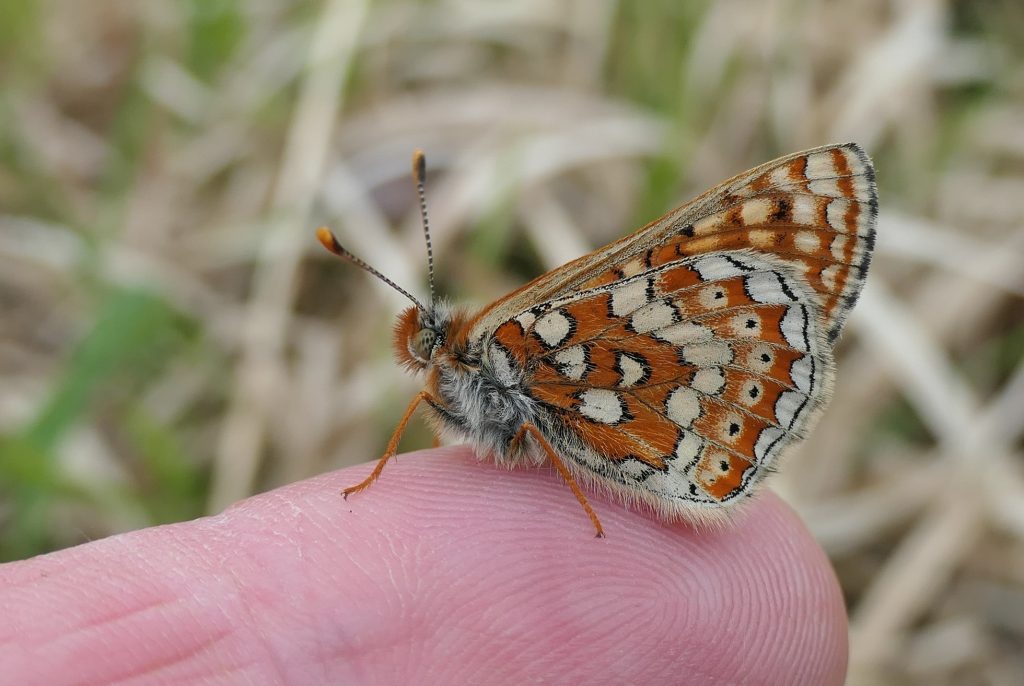
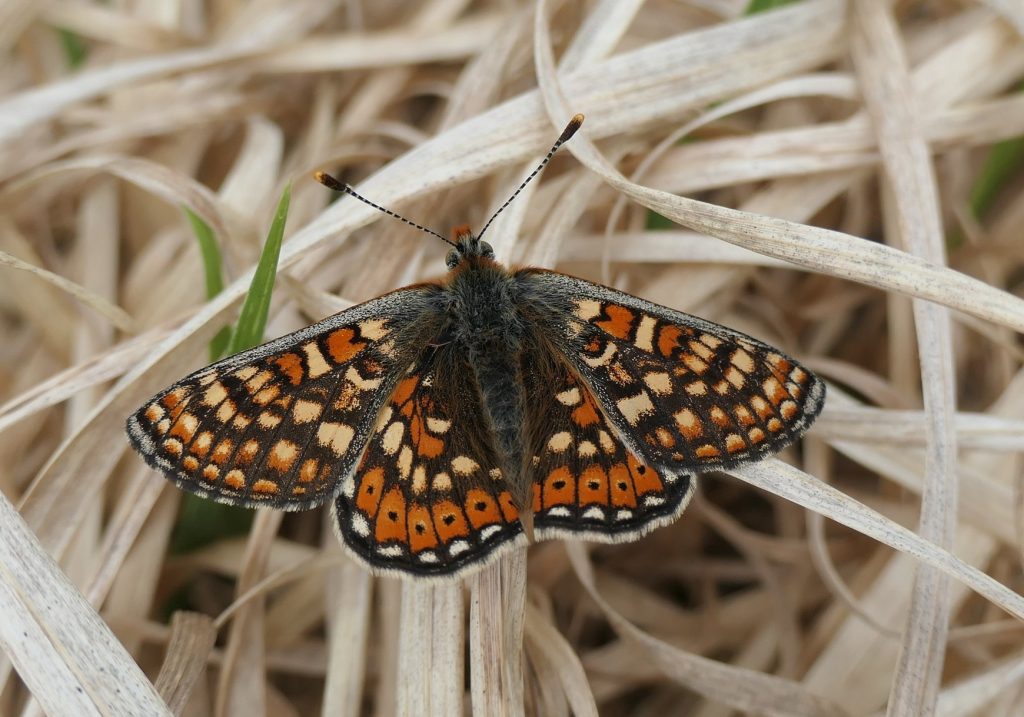
Marsh Fritillary male upperside, Lullybeg, County Kildare.
Nevertheless, the distribution change reported in the Atlas in the 2010-2021 period is +43%, indicating a positive trend. This positive finding is supported by the findings of the most recent report by the state to the EU Commission, ‘The Status of EU Protected Habitats and Species in Ireland 2025′, which assessed the Overall Status of Marsh Fritillary as
Favourable, which represents a genuine improvement since the Inadequate assessment reported in 2019. The change is because of an improvement in the future prospects for range, population and habitat for the species. Threats and pressures do exist but are not considered to be severe or extensive. The overall trend is improving. (NPWS, 2025, Vol. 1, p.52 )
However, this report states that 90% of Ireland’s EU priority habitats are in unfavourable condition, including several habitats used by the species: Molinia meadows, orchid-rich calcareous grassland, alkaline fens, wet heaths, dry heaths, alpine and sub-alpine heaths, machair, dune slacks.
For example, the assessment for orchid-rich calcareous grassland concludes:
Despite a number of conservation-focused farming schemes which bring about localised and regional improvements, the Overall Status is assessed as Bad with a deteriorating trend due to on-going habitat losses mainly associated with unsuitable grazing regimes, agricultural intensification causing loss of species-rich communities, and abandonment of farmland resulting in succession to scrub. This result is unchanged from 2019 (NPWS, 2025, Vol. 1, p. 29 ).
The assessment of Molinia meadows concludes:
The Overall Status is Bad, as it has been for the last three monitoring periods, and the overall trend is still deteriorating, due to on-going losses of habitat. Significant historical losses of this habitat have also occurred since the EU Habitats Directive came into force. The main pressures on the habitat are associated with agricultural intensification (e.g. land drainage, fertiliser application), undergrazing and forestry (NPWS, 2025, Vol. 1, p. 30).
The loss drivers identified are common to many other habitats used by the species. A new threat, renewable energy infrastructure, threatens colonies in cutover bogs.
The development of scrub on Marsh Fritillary habitats on cutover bogs eventually removes breeding habitat. Colonies on cutover bogs are often temporary.
The Marsh Fritillary also occurs in habitats that do not correspond to the habitat types described in the manuals used to identify EU-protected habitats. The factors mentioned above also threaten these habitats. In addition, many midland populations are in cutover bogs where cutting has ceased. These are becoming overgrown with scrub and woodland, shading the habitats and removing the butterfly; the Marsh Fritillary is shade intolerant.
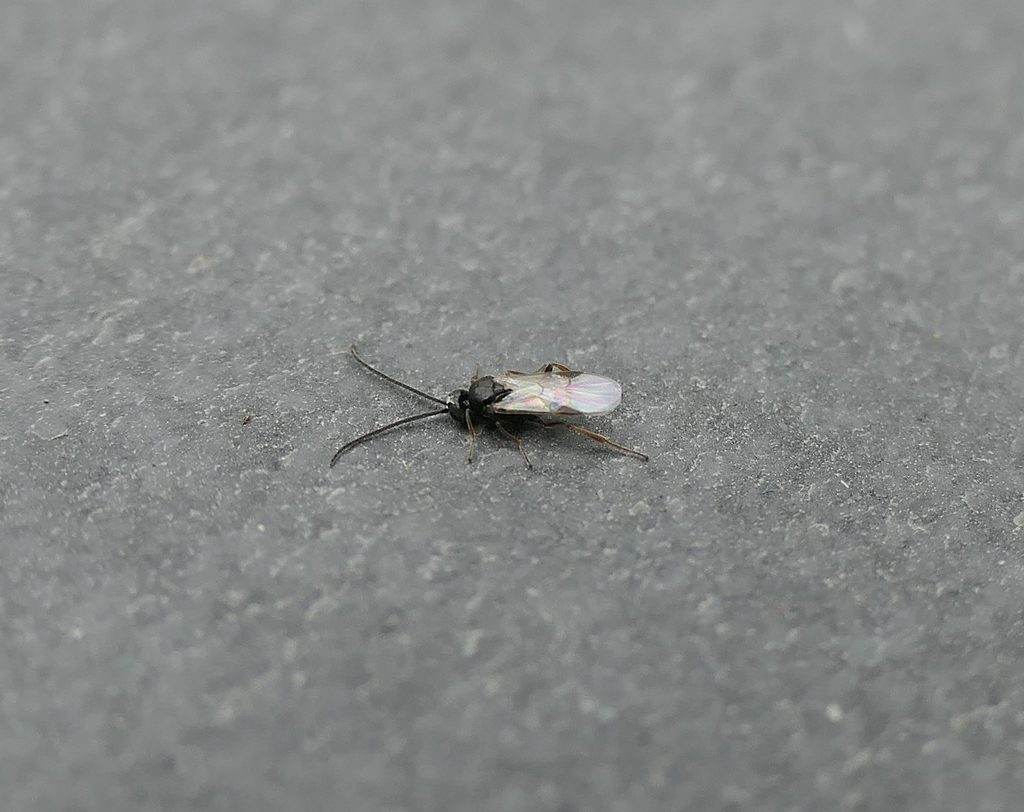
Cotesia bignelli, a major parasite of Marsh Fritillary. This wasp infects and eventually kills the caterpillars.
Conclusion
The continuing decline in the status of EU priority habitats in Ireland threatens many species, including Ireland’s only legally protected insect, the Marsh Fritillary. Unless the loss of habitat is stopped, the butterfly, which is rarely found more than 15km from a known colony and which has disappeared from many areas in northern Europe, will lose its ability to move around in the landscape, key to its capacity to repopulate sites where it has gone extinct due to the impacts of parasitism, unsuitable weather and deterioration of habitat.
Ireland has a low number of butterfly species. Can’t we protect the few we do have?
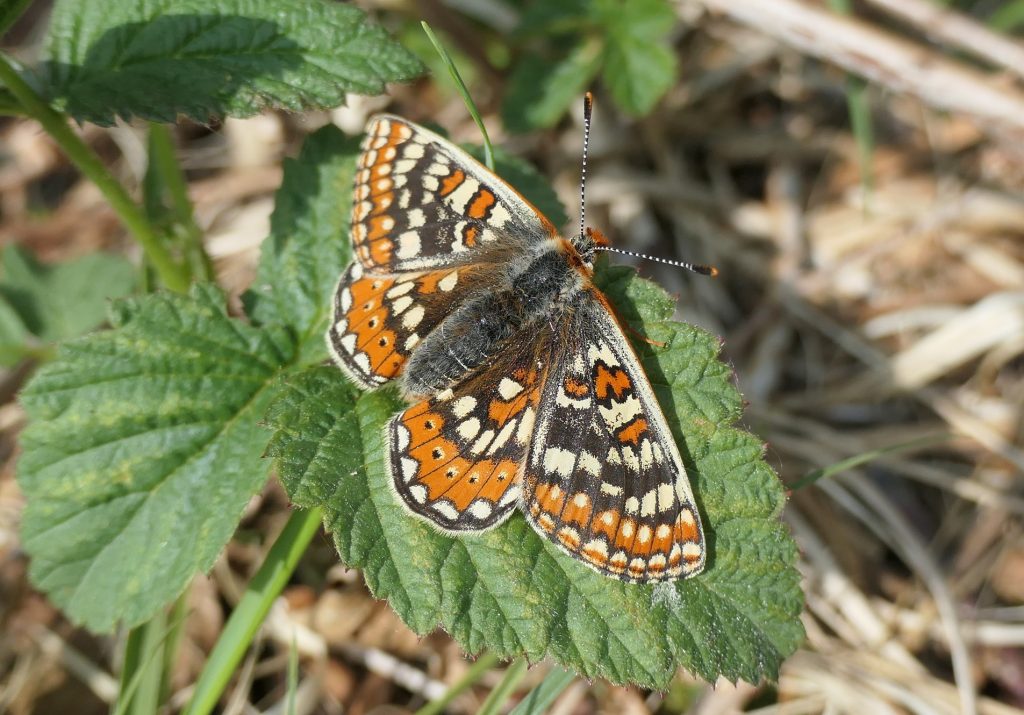
Marsh Fritillary female, firebreak, Lullybeg, County Kildare.
All photographs copyright J.Harding
References
Bulman, C.R., Wilson, R.J., Holt, A., Galvez Bravo, L., Early, R., Warren, M.& Thomas, C.D. (2007) Minimum viable metapopulation size, extinction debt, and the conservation of a declining species. Ecological Applications 17: 1460–1473.
Harding, J. & Lysaght, L. (Eds.) (2025) An Atlas of Butterflies in Ireland 2010-2021. The National Biodiversity Data Centre, Waterford.
NPWS (2019). The Status of EU Protected Habitats and Species in Ireland. Volume 3: Species Assessments. Unpublished NPWS report. Edited by: Deirdre Lynn and Fionnuala O’Neill
NPWS (2025). The Status of EU Protected Habitats and Species in Ireland. Volume 1: Summary Overview. Unpublished NPWS report.
Edited by: Domhnall Finch, Aoife Delaney, Fionnuala
O’Neill and Deirdre Lynn
NPWS (2021) Conservation Objectives: Ballynafagh Lake SAC 001387. Version 1. National Parks and Wildlife Service, Department of Housing, Local Government and Heritage.
NPWS (2019) Conservation Objectives: Barrigone SAC 000432. Version 1. National Parks and Wildlife Service, Department of Culture, Heritage and the Gaeltacht.
NPWS (2021) Conservation Objectives: Bricklieve Mountains and Keishcorran SAC 001656. Version 1. National Parks and Wildlife Service, Department of Housing, Local Government and Heritage.
NPWS (2015) Conservation Objectives: Bunduff Lough and Machair/Trawalua/Mullaghmore SAC 000625. Version 1. National Parks and Wildlife Service, Department of Arts, Heritage and the Gaeltacht.
NPWS (2015) Conservation Objectives: Connemara Bog Complex SAC 002034. Version 1. National Parks and Wildlife Service, Department of Arts, Heritage and the Gaeltacht.
NPWS (2022) Conservation Objectives: East Burren Complex SAC 001926. Version 1. National Parks and Wildlife Service, Department of Housing, Local Government and Heritage.
NPWS (2015) Conservation Objectives: Gweedore Bay and Islands SAC 001141. Version 1. National Parks and Wildlife Service, Department of Arts, Heritage and the Gaeltacht.
NPWS (2021) Conservation Objectives: Moneen Mountain SAC 000054. Version 1. National Parks and Wildlife Service, Department of Housing, Local Government and Heritage.
NPWS (2017) Conservation Objectives: Killarney National Park, Macgillycuddy’s Reeks and Caragh River Catchment SAC 000365. Version 1. National Parks and Wildlife Service, Department of Culture, Heritage and the Gaeltacht.
NPWS (2014) Conservation Objectives: Sheephaven SAC 001190. Version 1. National Parks and Wildlife Service, Department of Arts, Heritage and the Gaeltacht.
NPWS (2015) Conservation Objectives: St. John’s Point SAC 000191. Version 1. National Parks and Wildlife Service, Department of Arts, Heritage and the Gaeltacht.
NPWS (2015) Conservation Objectives: West of Ardara/Maas Road SAC 000197. Version 1. National Parks and Wildlife Service, Department of Arts, Heritage and the Gaeltacht.