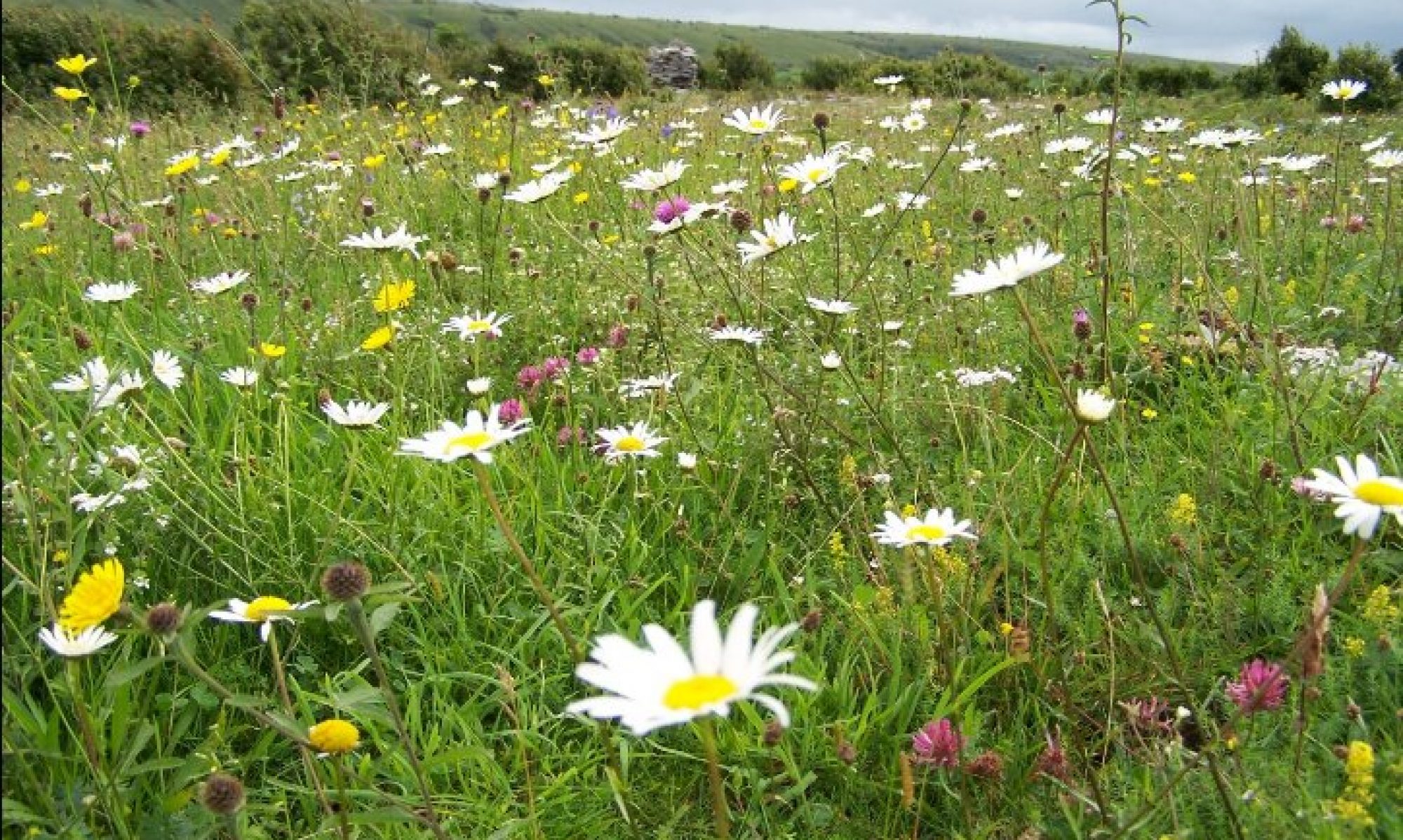
The golden September we often get is not ours in 2026, but many sunny Septembers offer a modicum of compensation for miserable summers. Summer 2026 was glorious, surpassing 1976 and 1989. Will it pass into the collective memory as a standout summer? That might depend on how we interpret climate data. We are in a time when hot, sunny weather is characterised as evidence of the collapse of the stability that has long characterised the global climate. Can’t we enjoy a hot summer without worrying? Apparently not.
That is not to be flippant about climate change, whether human-induced or arising from other influences. However, a remarkable feature of lepidopteran ecology is the rapid response to changing seasonal, climatic and environmental conditions. Changing climatic conditions can mean that ecological conditions within an area that were previously unsuitable for breeding become available for breeding. This is happening in Europe, Britain and Ireland.
The northward shift in butterfly and moth ranges is particularly evident in Europe, where range expansion does not require crossing water bodies. Species like the Map butterfly and the Peacock butterfly are extending their European range northward. The Brown Argus, formerly confined to breeding on Common rock-rose in the warmest habitats on chalk and limestone grassland in Southern England and Wales, has now expanded its British range, using cranesbills in cooler grasslands because the warming climate allows it to use these larval foodplants.
Range expansions in continental Europe influence Britain and Ireland to a lesser degree; many species expanding on the continent will avoid crossing seas. However, migrant species are more mobile, and some show indications of establishing populations in these islands.
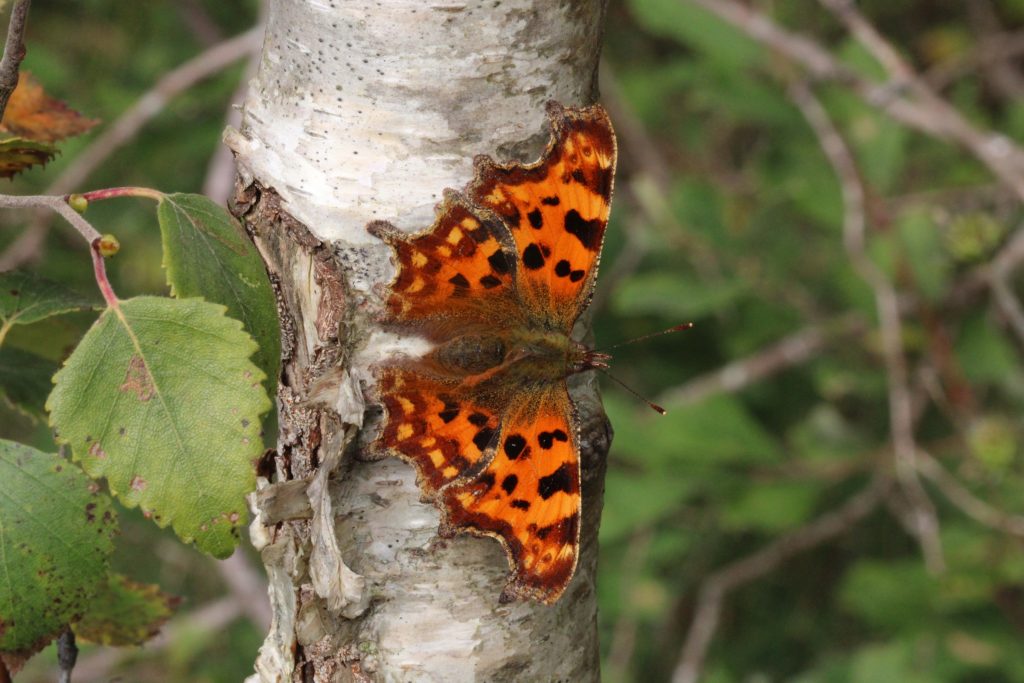
The most notable expansion from an Irish viewpoint is the Comma. Unknown in the Republic of Ireland before 2000, it has now been recorded in more than half of Ireland’s 10km squares, and its northward and westward expansion continues.
The lush Stinging Nettles along damp hedgerows, wood rides and edges, riverbanks and elsewhere suit it perfectly. It is thriving, producing two generations and is now a staple part of the butterfly experience in the east and midlands. Hedges holding blackberries and flowering ivy are the places to look in the general farmed countryside; wet grasslands and dry limestone grasslands with Devil’s-bit Scabious are also likely per-hibernation feeding grounds.
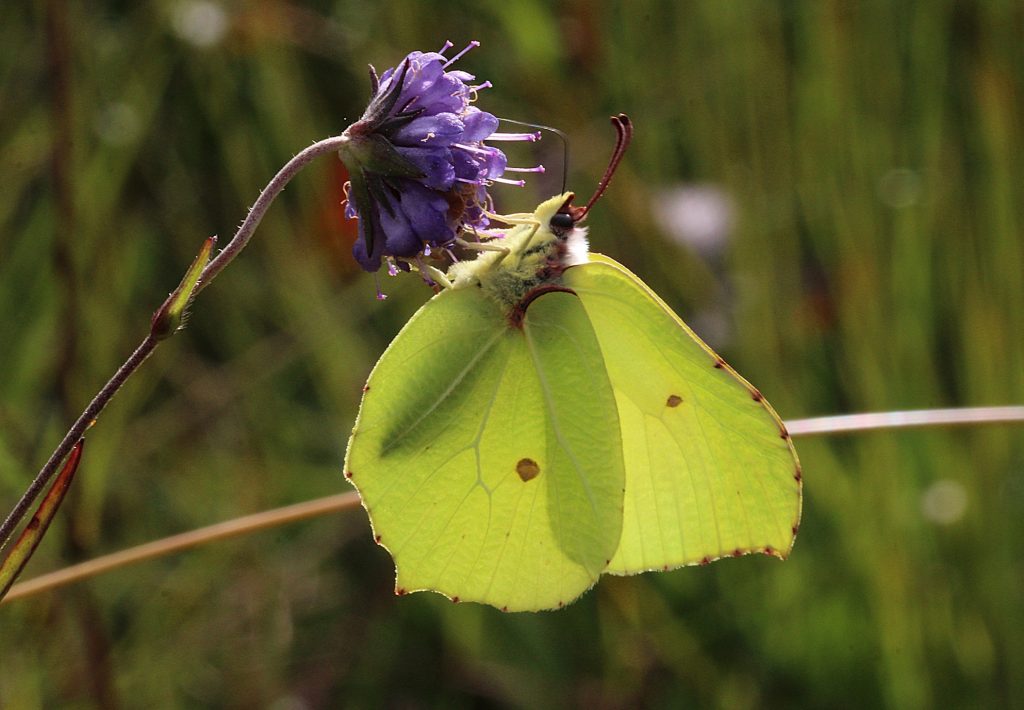
A stay-at-home butterfly to look for in September is the Brimstone. Most are in hibernation, but a few still feed on late flowers, especially Devil’s-bit Scabious, before disappearing into woods, scrub and dense grassland vegetation until next spring.
A glorious autumn moth that flies in a single generation in September-October is Merveille du Jour Griposia aprilina. Its scientific name is a strange choice. Carl Linnaeus named it after April, when it is a larva, munching on oak leaves. Perhaps Linnaeus was thinking of the moth’s verdant colouring when composing the name. The moth is best imagined on oak boughs encrusted with lichens, where it becomes virtually invisible.

An immigrant moth recorded in several places in Ireland this September is the impressive Clifden Nonpareil. Named after the magnificent early Victorian Cliveden House, Buckinghamshire, where it was first recorded in England (Marren, 2019), it is a huge moth by European standards, mottled grey on its forewing upperside, strikingly contrasted with a black hindwing upperside with a band of bright shimmering blue, like watered silk. It was an extreme rarity in Britain, but it is now established as a resident in England since about 2007. It is spreading northward there but remains very rare. It has been found in Wicklow but is extremely rare in Ireland, with only 25 individuals recorded up to March 2024 (https://www.mothsireland.com/images/72076.gif). The moth uses Aspen and poplars for breeding.
The recent increase is exciting. Could this magnificent creature take up residence in Ireland? The warming climate should help.

Returning to butterflies, the Small Copper is a resident, although it has been recorded at sea, on a light vessel 12 km off the Sussex coast (Thomas, 2010). This year three adult generations were produced: the first from mid-May to later in June, the second from mid-July to late August and the third, which began to fly in numbers from mid-September.
The summer drought did not damage its larval foodplants (Common and Sheep’s Sorrel) on wetter or heavier, moisture-retaining soils. Whether it affected its foodplants growing in drier habitats like dune slacks is unknown. Adults can live for a month or even longer, so it will fly into October.

The Small Copper does not always produce a third generation in Ireland, and when it does, this is unlikely to occur throughout the country. This is weather-dependent. It produced a large second generation in 2025, the warmest summer on record before the summer of 2026. A much smaller third generation appeared in 2023, when the summer weather was wet.
The Riband Wave moth usually has one generation, but a partial second generation flies in years with favourable weather. I am seeing it in some numbers in my garden in County Meath this September. It did not appear in my moth trap during September 2025.

Population size also varies according to environmental conditions. Parasitism, predation by non-parasitoid species, resource availability and the time of year influence population size. This year has seen huge populations of the Setaceous Hebrew Character moth, especially its second generation, which flies from August to October. Moth trappers are reporting hundreds; in August, one trap in Pollardstown Fen had over 400 individuals. The moth breeds on a range of herbaceous plants, including Stinging Nettle, burdocks and willowherbs. According to the Field Guide to the Moths of Great Britain and Ireland (Third Edition), it flies in two generations in the southern half of Britain and in one north of Yorkshire. It is certainly flying in two generations in the southern half of Ireland. It will be interesting to see if it produces a third generation early in winter.

The Canary-shouldered Thorn is a lovely late summer and autumn moth. It breeds on trees, especially birches and willows. The vernacular name needs no delineation, but its scientific genus name, Ennomos, is obscure. It means ‘within the law.’

A much more sombre-looking moth, the Spruce Carpet, also flies in September. It can sometimes be seen in daylight resting on walls. It breeds on conifers, including some non-native trees like Douglas Fir, but it also uses native Scots Pine.

The Beaded Chestnut is a common autumn-flying moth with much variety in its depth of colour. Some are almost amber, others yellow-brown, others brown. In some years it appears in large numbers. The young caterpillar feeds on buttercups, clovers and chickweeds before moving to native trees, especially Common Hawthorn.

Finally, a resident moth that blends in well with autumnal greenery is the appropriately named Brindled Green.

Brindled Green breeds on oak and has a scattered distribution in Ireland (https://www.mothsireland.com/images/73225.gif). The green caterpillars feed in April and May. I don’t find this species in my garden every year, so it feels great when I do!
A final point to consider is your planting choices. The breeding plants for all the species described in this post are stated. Please help our butterflies and moths by growing at least some of the plants mentioned. Most moths I trap in September fly into native trees when released. That’s a clue!
References
Marren, P. (2019) Emperors, Admirals & Chimney Sweepers. Little Toller Books, Dorset.
Moths Ireland 2026. Maps Macro English. Available at: https://www.mothsireland.com/maps-overview/maps-macro-english/ (Accessed 25 September 2026)
Thomas, J. and Lewington, R. (2014) The Butterflies of Britain and Ireland. (Revised edition) British Wildlife Publishing, Dorset.
